East Texas Legacy Coalition

The ones who stood up for this place

Heroes in Deep East Texas don’t usually get statues. They get a road named after them, or a patch of woods that’s still standing because they wouldn’t let it go. Here are some of the people who looked after our land and water before it was our turn.

1912–2007Born in Karnack, Harrison County

Lady Bird Johnson
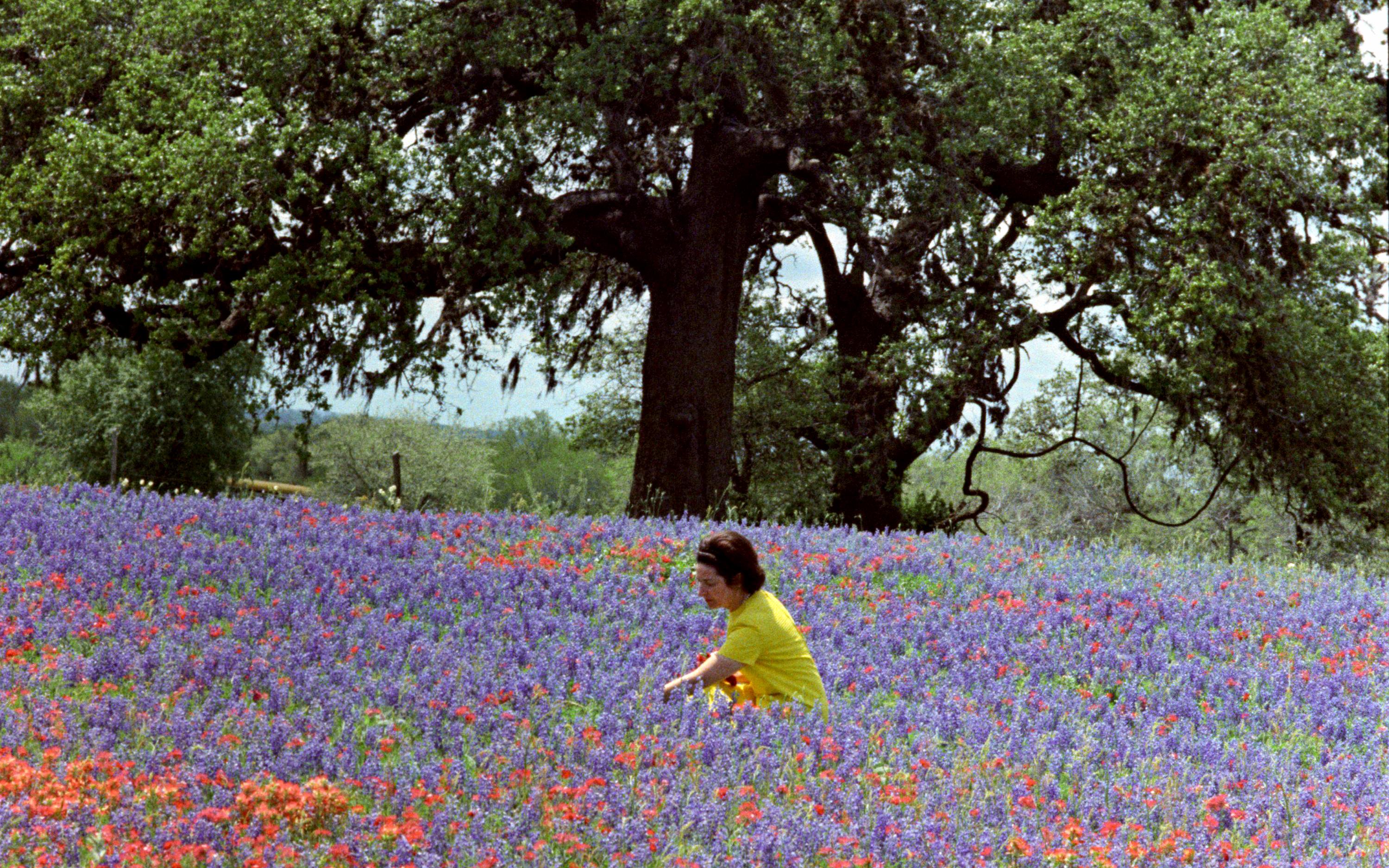
Lady Bird Johnson sitting among bluebonnets and Indian paintbrush in Central Texas, 1968
Lady Bird Johnson among bluebonnets and Indian paintbrush, Central Texas, 1968. Photo by Robert Knudsen, LBJ Presidential Library (C9479-17), public domain.

Before she was a first lady, Claudia Alta Taylor was a little girl in Karnack, a crossroads town of about a hundred people near the Louisiana line. A nursemaid said she was “as purty as a lady bird,” and the name stuck for life.

She grew up to run the first major legislative campaign ever led by a first lady. The Highway Beautification Act of 1965, which folks called “Lady Bird’s Bill,” went after billboards and junkyards along the new interstates. She insisted it was never just about looking pretty. In her diary she wrote that clean water, parks, pollution and poverty were all one tangled skein: “All the threads are interwoven.”

  • Signed into law Oct. 22, 1965: the Highway Beautification Act.
  • 1969: started the Texas Highway Beautification Awards and paid the winners out of her own checkbook for twenty years. That’s a big reason Texas roadsides bloom with bluebonnets and paintbrush every spring.
  • 1982, on her 70th birthday: founded the National Wildflower Research Center to protect native plants. It became the Lady Bird Johnson Wildflower Center in 1997 and is now part of the University of Texas.
“All the threads are interwoven.”Lady Bird Johnson, diary entry, Jan. 27, 1965
Sources: LBJ Presidential Library (born Karnack, Dec. 22, 1912; the nickname); Marion County Herald (Harrison County); Vineyard Gazette obituary (Karnack, population 100); Texas House Concurrent Resolution 253 (2009) (first major legislative campaign by a first lady; “Lady Bird’s Bill”); EBSCO Research Starters (signed Oct. 22, 1965); LBJ Library biography (beautification awards, 1982 founding); LBJ Library biography as reprinted by Denton ISD (1969 start of the awards); Lady Bird Johnson Wildflower Center (1997 renaming, UT Austin); USPS Stamp of Approval blog (diary quote and date).
1886–1970Born south of Saratoga, Hardin County
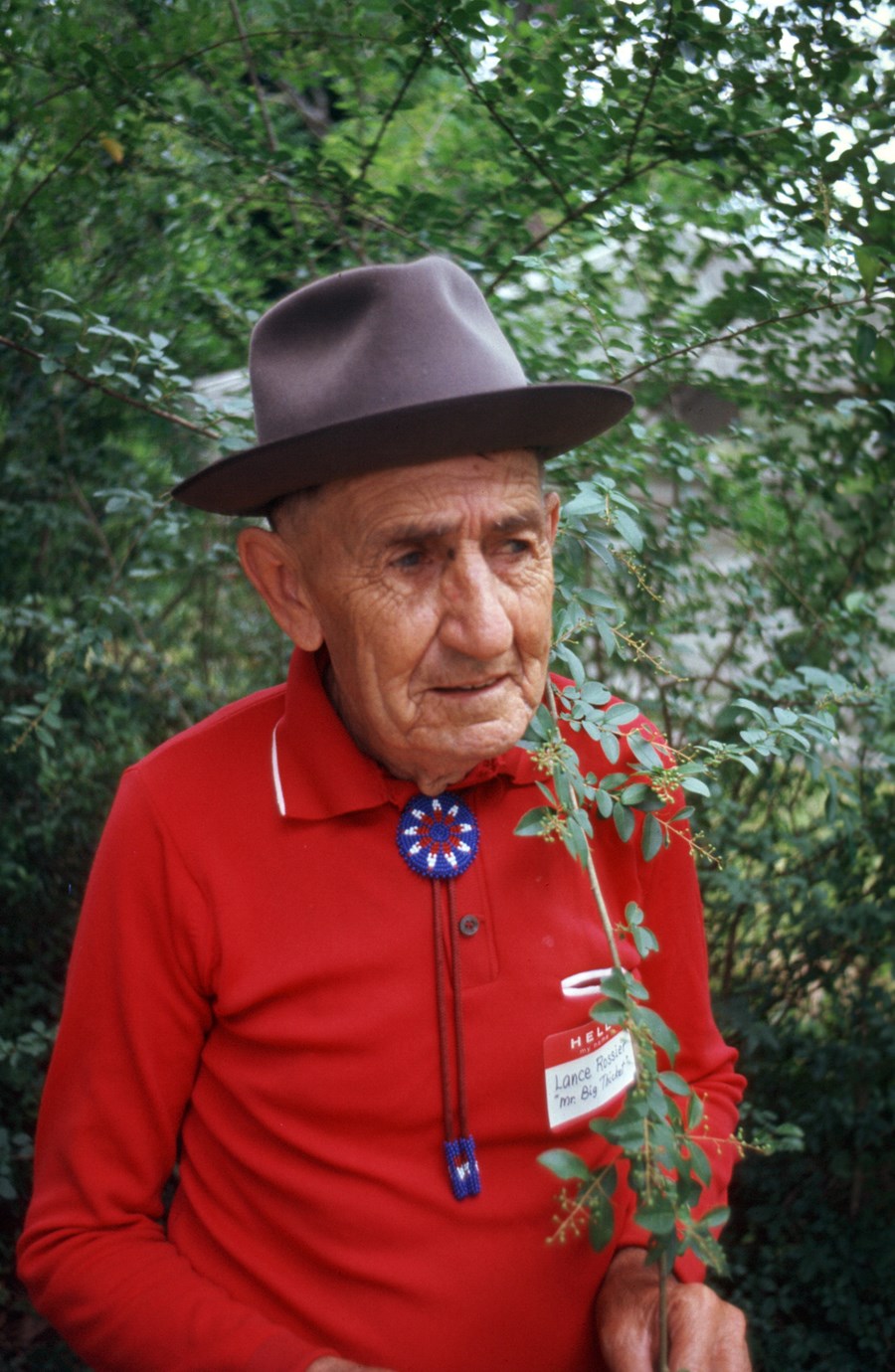
Portrait of Lance Rosier as an older man in a red shirt, brown hat and bolo tie
Lance Rosier. Photographer unknown. Courtesy National Park Service.

Lance Rosier, “Mr. Big Thicket”

Lance Rosier grew up in his aunt’s boarding house in Saratoga and never had much use for hunting game or chasing a paycheck. He hunted flowers. He’d wander the Thicket for days, and with no formal schooling he came to know just about every plant in it. By the 1960s, conservationists and politicians who wanted to understand the Thicket had come to know him.

He spent his life pushing to protect it from the timber and oil companies, and he died in 1970, four years before the preserve became law. The largest unit of Big Thicket National Preserve carries his name.

Sources: National Park Service, “Lance Rosier”; NPS, Lance Rosier Unit sign; Texas Highways (largest of the preserve’s 15 units); Texas Observer, Aug. 29, 1969 (politicians and conservationists knew him).
A small bridge over a creek with cypress knees in the foreground
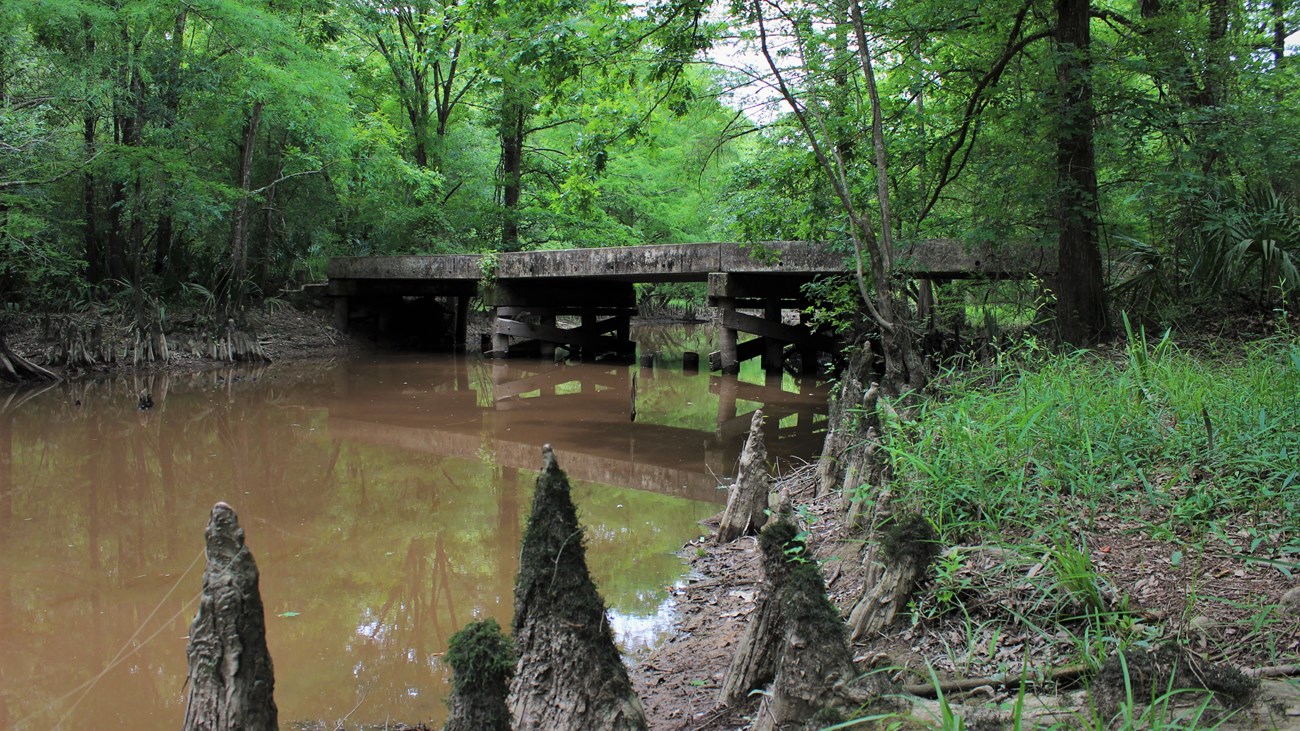
The “Bridge to Nowhere” over Little Pine Island Bayou, in the Lance Rosier Unit that carries his name. NPS photo by Scott Sharaga, via National Park Service.
1964–1974Saratoga to Washington
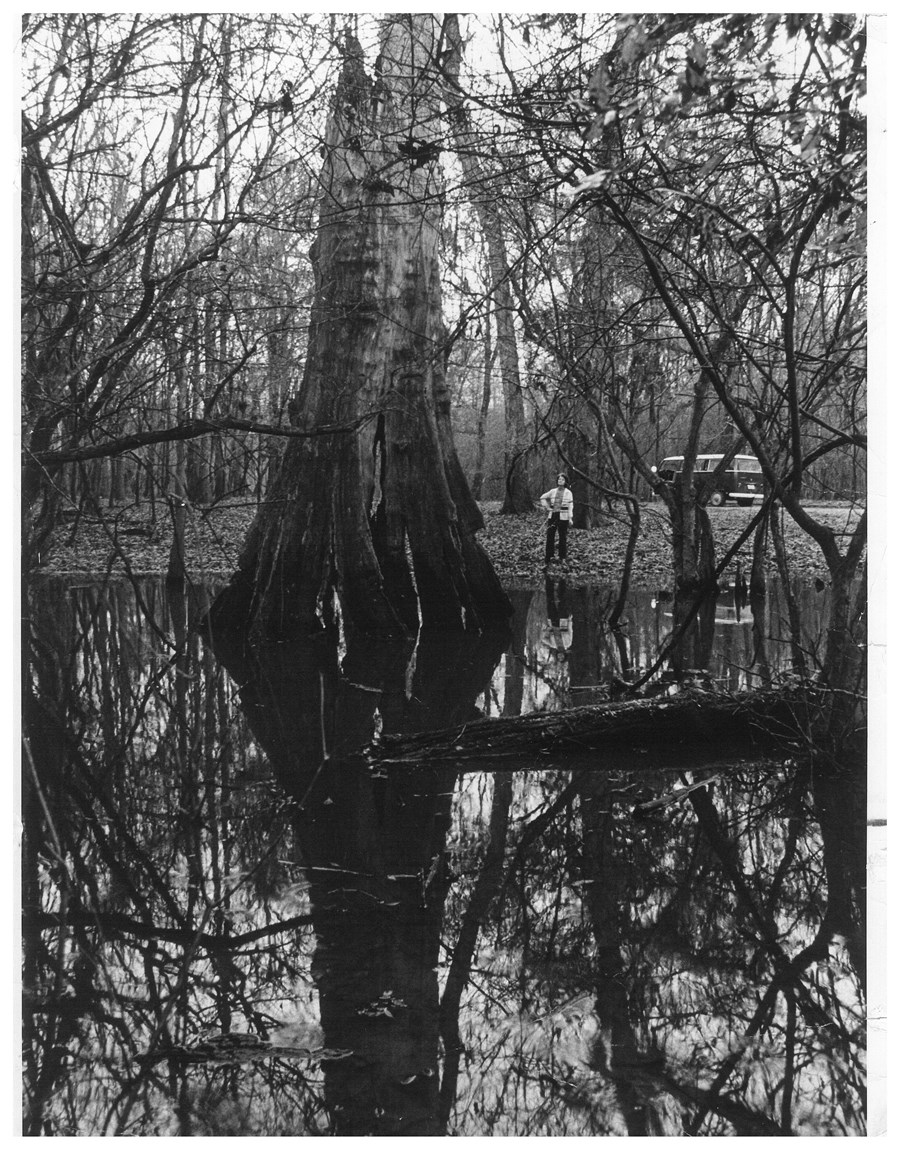
Geraldine Watson standing at the edge of a pond looking at a large dead cypress tree, 1973
Geraldine Watson surveying a dead cypress, 1973. Photographer unknown. Courtesy National Park Service.

The neighbors who wouldn’t quit

In October 1964, local people met at the Saratoga Methodist Church and started the Big Thicket Association. Botanist Geraldine Watson, who grew up in the region, fought beside Rosier, Ned Fritz and Maxine Johnston, and later became the preserve’s plant ecologist. Senator Ralph Yarborough and Congressmen Bob Eckhardt and Charlie Wilson carried it in Washington. On Oct. 11, 1974, it became law.

Ten years of meetings, letters and showing up. That’s the playbook. It still works.

Sources: Big Thicket Reporter #121 (1964 founding meeting); Texas Parks & Wildlife magazine, July 2024 (Watson, Fritz, Johnston); Sierra Club Houston (Yarborough, Eckhardt, Wilson, Bentsen); NPS (signing date).
1965Big Thicket Association

Dempsie Henley

Lance Rosier recruited him to lead the new Big Thicket Association. In 1965 Henley invited U.S. Senator Ralph Yarborough to come see the Thicket for himself, with Rosier as the guide. That trip is what persuaded Yarborough to push for protecting it in Washington. Sometimes the most important thing an advocate does is get the right person into the woods.

Source: National Park Service, “Lance Rosier”.
Since 1964Batson and Beaumont

Maxine Johnston, the godmother of the Big Thicket

A librarian. She joined Lamar University’s library in 1955 and became its director in 1980. She joined the Big Thicket Association in 1964, served as its president twice, from 1972 to 1975 and from 1994 to 1998, edited its newsletters and led people on tours of the Thicket. Rosier and Geraldine Watson were her friends.

She also did what librarians do best: she saved the record. At Lamar she built an archive on the Big Thicket that runs to 25 collections, and she arranged for Larry Jene Fisher’s photographs to land there. In 2024, at 95, Texas Monthly reported she was still at it.

Sources: Lamar University, 2018 (1955; association since 1964; presidencies); Texas Parks & Wildlife magazine, January 2020 (director in 1980; 25 collections; “godmother”); National Parks Conservation Association (newsletters and tours); Texas Monthly (friendships with Rosier and Watson); Lamar University, Larry Jene Fisher Collection (donated by Maxine Johnston); Texas Monthly, Oct. 16, 2024 (95 and still fighting).
1902–1950sSaratoga, Hardin County

Larry Jene Fisher, the man who saved the Thicket’s faces

An organist, aviator, playwright and filmmaker who moved to Saratoga around 1940 and lived there about 15 years. Through the 1930s and ’40s he photographed Big Thicket people living the old way: syrup mills, deer hunts, rooter hogs, railroad tie making, barrel staves. He knew that way of life was ending, and he made sure it was recorded. His photographs of the Thicket’s plants and animals helped the first push to protect it.

His pictures sat neglected for nearly 50 years until a 2000 exhibit brought them back. Lamar University now holds thousands of them, and many are free to view online.

See his photographs on the Portal to Texas History

Sources: Lamar University, Larry Jene Fisher Collection (born 1902; Saratoga about 15 years; role in the first preservation movement); University of Texas Press, Big Thicket People (1930s–40s folk life); Texas Co-op Power (8,000 scanned images); Texas Observer (neglected nearly 50 years; 2000 exhibit).
1729–1809Nacogdoches

Antonio Gil Y’Barbo

When Spain ordered East Texas settlers to abandon their homes in 1773, Y’Barbo kept petitioning to bring them back. In 1779 he led them home and rebuilt Nacogdoches. Plenty of people talk about loving a place. He walked a whole town back to it.

Sources: SNAC, Antonio Gil Y’Barbo records (UT Libraries; SFA East Texas Research Center); National Register nomination, Nacogdoches.
1990s–2010sVictoria, Texas

Kenneth Schustereit

The San Antonio Current called him “the gender-switch Erin Brockovich.” Kenneth Schustereit was an industrial electrician and pipe fitter from Victoria with a high school diploma. He got into water the hard way: a man working on his parents’ well told him that someday he’d have to put a meter on it and pay for the water under his own land. So he started reading.

He’d come to public meetings in his blue work clothes, straight off a nine-hour shift, carrying photocopies of Chapter 36 of the Texas Water Code. The state’s experts brought laptops. He brought the law. He fought “the GBRA deal,” a plan to pump 94,000 acre-feet of Guadalupe River water a year more than 130 miles uphill to San Antonio. He pushed the Texas Water Development Board to account for leaking oilfield injection wells in its groundwater models. When voters in Victoria, Lavaca, Colorado and Comal counties turned down the proposed groundwater districts in November 2001, the Victoria Advocate credited him by name.

A retired civil engineer on San Antonio’s water advisory panel met with him and vouched for his facts. He was still speaking up during public comment at Guadalupe-Blanco River Authority board meetings in 2015.

You don’t need a degree to read the law. You need a copy of it and the nerve to stand up.Our takeaway from his story
Sources: Steve Badrich, “Bad Deal for Bad Water,” San Antonio Current, June 20, 2002; Guadalupe-Blanco River Authority board minutes, March 18, 2015 (public comment).
1860–1950Temple, Texas

W. Goodrich Jones, the father of Texas forestry

A banker, not a forester. In 1898 he rode horseback across East Texas to see the timber for himself, and came back with a bleak report. In 1914 he gathered about 20 people in the Carnegie library in Temple and founded the Texas Forestry Association. A year later the Legislature created the state’s forestry department, which became the Texas Forest Service. His motto was simple: for every tree cut, plant a tree.

Sources: Texas Historical Commission marker 2849 (1914 association; 1915 law); “Site of Organization of the Texas Forestry Association” marker, Temple (Carnegie library meeting); Texas A&M Forest Service presentation (1898 horseback survey); Sierra Club Houston (his motto); W. Goodrich Jones Papers, SFA East Texas Research Center.
1916–2008Dallas, fighting for East Texas

Ned Fritz, the father of Texas wilderness

A Dallas lawyer who retired from his law practice in 1974 and spent the rest of his life fighting for Texas land. He founded the Texas Committee on Natural Resources, now the Texas Conservation Alliance. In 1976 he sued the Forest Service over clearcutting in our national forests, and he kept suing for decades. His endangered species case, built around the red-cockaded woodpecker, ended clearcutting on 200,000 acres of Texas national forest land and set woodpecker habitat rules across the Southeast.

He also fought for the Big Thicket and helped win five wilderness areas in East Texas. Two of them, Turkey Hill and Upland Island, are in the Angelina National Forest, right here at home.

Sources: Forest History Society / USDA Forest Service, history of litigation (July 2, 1976 suit); Texas Conservation Alliance (200,000 acres; woodpecker guidelines); TCA tribute (five East Texas wilderness areas); Wikipedia (retired 1974); Sierra Club Houston (Turkey Hill and Upland Island wilderness, Angelina National Forest).
1993–2005Caddo Lake, Harrison County

Dwight K. Shellman Jr.

Everybody knows Don Henley helped save Caddo Lake. Fewer know the Colorado lawyer Henley recruited to do the work. Dwight Shellman came in December 1992, moved part time to the lake, and made friends with the people who lived there. Through the Caddo Lake Institute, the lake was named a Wetland of International Importance in 1993. He organized the first real scientific study of the lake, and pushed for years to turn a closed Army ammunition plant on the south shore into a wildlife refuge.

When Caddo Lake National Wildlife Refuge finally opened in September 2009, he was too sick with ALS to attend. The visitor center there carries his name.

Sources: Associated Press via Pollstar, May 3, 2011 (recruitment, research, refuge, 2009 opening); Caddo Lake Institute (visitor center named for him; president 1993–2005); Wikipedia, “Caddo Lake” (Ramsar designation, Oct. 23, 1993).
2006–2010The upper Neches River

The folks who kept the Neches running

For decades the state had the upper Neches marked for a Dallas reservoir called Lake Fastrill. In 2006 the U.S. Fish and Wildlife Service approved a 25,281-acre wildlife refuge in the same footprint instead. Dallas and the Texas Water Development Board sued. East Texans fought back, led by the Texas Conservation Alliance under Janice Bezanson and the Friends of the Neches River. They argued Dallas could get its water from reservoirs it already had. In February 2010 the U.S. Supreme Court declined to hear the case, and the refuge stood.

Sound familiar? A big city wanted East Texas water, and the state’s water agency was on its side. Neighbors who did their homework won anyway.

Sources: Pacific Standard (25,281-acre refuge approved June 2006); National Wildlife Federation, June/July 2010 (Dallas and TWDB suit; Supreme Court declined; TCA led the fight); Big Thicket Reporter #104 (Bezanson and Michael Banks of Friends of the Neches River, Feb. 22, 2010); Texas Observer (existing reservoirs argument).

Fighting right now

Not every steward is history. These East Texas fights are still going, and the people in them are writing the next chapter. Some of these cases are still in court, so we stick to what’s on the record.

2025–nowAnderson, Henderson and Houston counties

The rural uprising over the Carrizo-Wilcox

Companies tied to Dallas investor Kyle Bass applied to pump roughly 15 billion gallons a year out of the Carrizo-Wilcox through dozens of high-capacity wells, to export it out of the area. Neighbors packed the Neches & Trinity Valleys Groundwater Conservation District meeting in Jacksonville in June 2025. Wayne-Sanderson Farms, which contracts with hundreds of family farms, sued the district. The fight reached an 11-hour legislative committee hearing, and the district voided the original permits in a settlement. A judge later issued a final judgment and permanent injunction pausing the project until studies are done.

On May 21, 2026, the district adopted a moratorium on new permits for projects that don’t serve local use. The Bass companies sued in federal court in Tyler that July, and in October 2026 one piece of the fight was argued before the 12th Court of Appeals.

Sources: Grist (about 15 billion gallons; June 19 Jacksonville meeting); KLTV, July 21, 2025 (Sanderson lawsuit; family farms; three counties); Texas Tribune, Oct. 21, 2025 (11-hour hearing; permits voided); Tyler Morning Telegraph, Nov. 27, 2025 (final judgment and permanent injunction); Texas Tribune, July 8, 2026 (May 21, 2026 moratorium; federal suit); Texas Lawbook (12th Court of Appeals arguments).
2025–nowLake O’ the Pines

David Simpson and Lake O’ the Pines

East Texans have opposed a proposed sale of Lake O’ the Pines water to the Dallas-area North Texas Municipal Water District since the news broke in January 2025. Former state Rep. David Simpson of Avinger sued the water district that manages the lake, saying it broke the Texas Open Meetings Act by negotiating the sale without public notice.

Source: Tyler Morning Telegraph, Oct. 14, 2025.

Know a steward we missed?

A teacher who planted trees with every class, a rancher who kept his creek clean, somebody who stood up at a meeting when nobody else would. Tell us who they are and what they did, and send a source if there is one: a news story, an obituary, a plaque. Email contact@grailsystems.io. We check every name before it goes up.