In 2013 Winnie Graham wrote down 165 years of one family’s life in these woods: the Renfros, Browns, Sowells, Russells and Grahams of Oak Flat. It’s our founder’s family, and it’s the Piney Woods story of a lot of families. Here it is, retold in our own words.
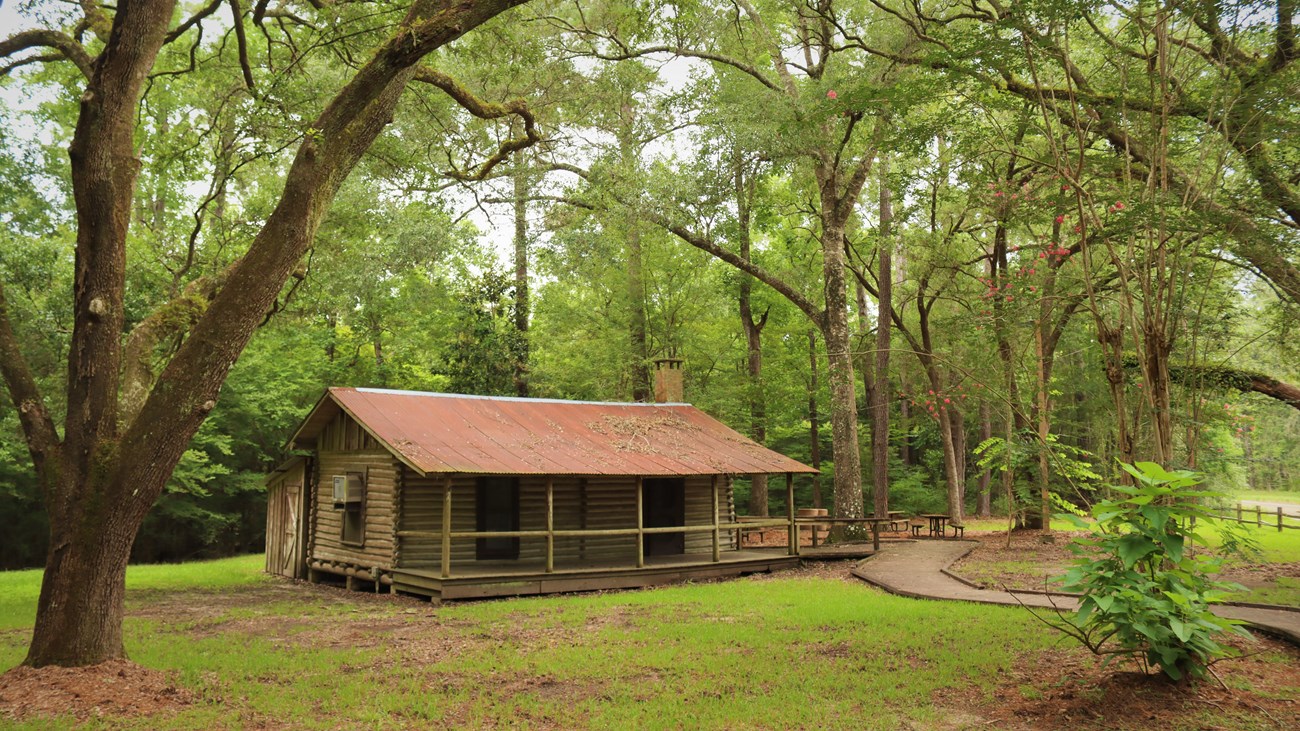
Staley Cabin, a homestead log cabin in the Big Thicket (not Oak Flat). NPS photo by Scott Sharaga.
The book
A family’s tales, and the woods kept butting in
Winnie Graham grew up in Lufkin and spent her summers at her grandparents’ place at Oak Flat, several miles outside Huntington. She earned an engineering degree, and years later she sat down to write a few family stories for the younger generation. What came out was Under the Blackgum Tree: 165 Years in the Piney Woods, published by Stephen F. Austin State University Press in 2013.
It’s a family memoir, but it’s also a field guide to how people lived here: what they ate, how they talked, what they sang, how they built and plowed and doctored their stock. Winnie was our founder’s kin.
Everything on this page comes from her book unless we say otherwise. Where her history slipped (she was writing from memory and family lore, and a few dates are off), we checked it against the record and tell you what the record says.
The place
Oak Flat, and the tree that named the book
Oak Flat is a farm settlement in the woods several miles outside Huntington, about 15 miles south of Lufkin. Winnie’s grandfather, Eli Russell, farmed a field there, and in that field stood a black gum tree. Generations later Winnie and her brothers still owned parcels of Grandpa’s field, and they planted it back in pines.
The settlement had a one-room church house lit by coal oil lamps, and before World War I folks held brush arbor revivals there. The county’s own records count 19 pupils at the Oak Flat school in 1895, meeting in the church. Winnie remembered a two-room schoolhouse; when the country schools consolidated, she wrote, it was moved to the Huntington campus. Oak Flat School No. 47 joined the Huntington rural high school district in 1939.
Later there were two painted churches, Baptist and Pentecostal. The Pentecostal one was Grandma Leah’s doing. Grandpa deeded just under an acre out of his cornfield, neighbors and kin built a plain one-room box church with no plumbing or lights, and young Winnie painted the sign with brushes she made out of rags. Services ran about five years. The building was later hauled off, and the acre has gone back to thicket.
Today the field is pines again. You can still find old house places in these woods by the jonquils and the scraggly roses somebody planted by a door.Winnie’s tip for spotting a vanished homestead, from Under the Blackgum Tree.
Sources: Winnie Graham, Under the Blackgum Tree: 165 Years in the Piney Woods (Nacogdoches: Stephen F. Austin State University Press, 2013), pp. 16–17, 49–57, 164–177; Bob Bowman, ed., Land of the Little Angel: A History of Angelina County, Texas (Lufkin: Lufkin Printing Co., 1976), p. 42 (Oak Flat school, 1895); Oak Flat School No. 47 consolidation (1939) from The History Center, Diboll.
How they got here
From Tennessee, Missouri and Arkansas
Winnie traced the family into Texas in three waves: one branch from Tennessee in 1838, one from Missouri in 1839, and one from Arkansas in 1853. Some settled first in Nacogdoches and San Augustine counties before landing in what’s now Angelina County.
One story came down about a little girl on the trip in, around 1839, crossing a river so wide and rough that when she got thirsty she drank from her own shoe. Nobody remembers which river.
Sources: Winnie Graham, Under the Blackgum Tree: 165 Years in the Piney Woods (Nacogdoches: Stephen F. Austin State University Press, 2013), pp. 15, 21.
The schoolmakers
The Renfros of Renfro Prairie
John Folkner Renfro was born in Kentucky in 1797. He married Rebecca Harrison Hicks in Missouri, and in 1839 they brought their family to Texas: a year in Sabine County, then, in 1840, a homestead on what came to be called Renfro Prairie in Angelina County. The county history says one of the first known schools in the county stood near his home, and in 1848 the Renfro place served as a polling place. The prairie’s community is called Beulah today.
What’s left of the home place, according to the county history: the first Renfro Cemetery, where he’s buried, an old cistern, and the cedar and crepe myrtle trees that marked the yard.
1840
A school on the prairie
One of Angelina County’s first known schools stood near the Renfro home. In 1895 the Renfro Prairie school had 24 pupils.
Sources: Bob Bowman, ed., Land of the Little Angel: A History of Angelina County, Texas (Lufkin: Lufkin Printing Co., 1976), pp. 41–42, 299.1900
Huntington’s first school
John F. Renfro, the pioneer’s grandson, graduated from Sam Houston Normal in 1899. Huntington’s first school opened in 1900 on the site of the Renfro home, and from 1903 to 1913 the school ran on John Renfro’s property.
Sources: Bob Bowman, ed., Land of the Little Angel: A History of Angelina County, Texas (Lufkin: Lufkin Printing Co., 1976), pp. 56, 299.1927
Huntington’s man in Austin
The same John F. Renfro, a Huntington landowner, banker and ordained minister, served in the Texas House from 1927 to 1931. The county history calls him an organizer and the second president of Huntington Guaranty State Bank.
Sources: Bob Bowman, ed., Land of the Little Angel: A History of Angelina County, Texas (Lufkin: Lufkin Printing Co., 1976), pp. 35, 299; Texas Legislative Reference Library, Texas Legislators: Past and Present.
Two women who held it together
Granny Hutch and Grandma Wade
John Renfro’s daughter, Margaret Lucinda, was born in Missouri in 1838 and came to Texas as a baby. She married John E. Brown on July 4, 1858. He went off to the Civil War in 1862, wrote letters home, and was never heard from again. Their daughter Kate was born in April 1863 and never knew him.
Margaret married again, to Aaron Hutchinson, an English-born Confederate cavalryman, and the family called her Granny Hutch from then on. After he died she drew a Confederate widow’s pension on his service. She lived until 1925.
Her daughter Kate grew up to be Grandma Wade, and she lived to be 90. She married Pat Sowell at 17 and settled around Smyrna, a cotton community the family called “Smernie.” Pat died in 1889, when their daughter Leah was five, and Kate raised her children through hard years. She outlived more than one husband and kept her independence: in her late 70s she bought a little house in Huntington, had it moved out to Oak Flat and made it a wallpapered cottage. She did the family’s churning until the end.
Grandma Wade’s ink
When she was young, folks made their own ink from oak galls. She’d forgotten the recipe, so when the children tried it they got only invisible ink. The missing piece was iron. Winnie’s version: crush a gall, stir it into water, drop in a rusty nail and let it sit for weeks.
Sources: Winnie Graham, Listening to Plants: A Pathway to New Uses (2020), pp. 9–11.
Grandma Wade’s owl
She’d call to the barred owls the old way, “who cooks for you all,” and Winnie said sometimes an owl would answer. Birders still teach that same phrase to learn the barred owl’s call.
Sources: Winnie Graham, Under the Blackgum Tree: 165 Years in the Piney Woods (Nacogdoches: Stephen F. Austin State University Press, 2013), pp. 65–66.
Grandma Wade’s rhymes
She had a verse for everything, from “Incie, pincie, cootsie corn” to “Up a hickory, down a pine.” Winnie wrote down a handful so they wouldn’t be lost. Find them in the book.
Sources: Winnie Graham, Under the Blackgum Tree: 165 Years in the Piney Woods (Nacogdoches: Stephen F. Austin State University Press, 2013), pp. 65–66.
The county’s last Confederate veteran
Grandpa Bill Russell
W. D. “Bill” Russell was born in Dallas County, Arkansas, in 1848 and came to Texas as a little boy of five. Near the very end of the Civil War, still a teenager, he joined up and was sent to Galveston. When it was over he walked home with the other boys, and Winnie wrote that a farm wife along the way fed them milk and cornbread.
He married Mary Chestnut, and they raised ten children. When he died in 1942 the county history counted him as Angelina County’s last surviving Confederate veteran. He’s buried at Jonesville Cemetery near Huntington. In 1934 a University of Texas student writing the first scholarly history of the county interviewed a W. D. Russell of Huntington about the old days.
Mary sent her son Eli a rose for his birthday. He rooted it and planted it in the middle of the cornfield, and for years the plowing went around it.From Under the Blackgum Tree.
Bill walked with a hickory cane that had been carved by hand by a formerly enslaved man in Alabama, cut with the words “Jesus, Walk With Me Today.” It broke once and was wrapped with wire, and it stayed in the family.
Sources: Winnie Graham, Under the Blackgum Tree: 165 Years in the Piney Woods (Nacogdoches: Stephen F. Austin State University Press, 2013), pp. 28–35; Bob Bowman, ed., Land of the Little Angel: A History of Angelina County, Texas (Lufkin: Lufkin Printing Co., 1976), p. 300; Effie Boon, The History of Angelina County (master’s thesis, University of Texas, 1937), list of interviews.
Grandpa and Grandma
Eli and Leah Russell of Oak Flat
William Eli Russell got about eight grades in a one-room school and learned the rest from the land: plowing, beekeeping, doctoring livestock. Winnie said he could walk straight to the wild plums, magnolias and persimmons in the woods with no trail. As a young man he drove a log wagon for a timber company and “batched” in a cabin in the woods. He won the ring at a Riding the Ring contest, a horseback tournament where riders speared hanging rings at a gallop, and then gave his prize to a different girl, which made Leah jealous. They married anyway, on March 9, 1901.
He became the settlement’s stand-in veterinarian. He built a banjo as a boy out of a hardwood disk and a cowhide head, later played the fiddle, and kept a blacksmith setup under an oak. He made chair bottoms out of hardwood inner bark and was known for them. He built twelve-room purple martin houses on tall poles and grew watermelons on contour rows the county agents helped farmers lay out to hold the soil and water. When he died in 1952, Winnie wrote, every store in town but one closed for his funeral.
Leah Azeta Sowell was born in Smyrna in 1884 and rode double with her brother on his horse to the Old Smyrna school. She picked cotton, made quilts and sunbonnets, wheelbarrowed in topsoil for her hollyhocks, zinnias, okra and tomatoes, and loved three things best: ice cream, church and fishing. She fished with a cane pole, standing up, never sitting, and kept her own earthworm bed fed on coffee grounds.
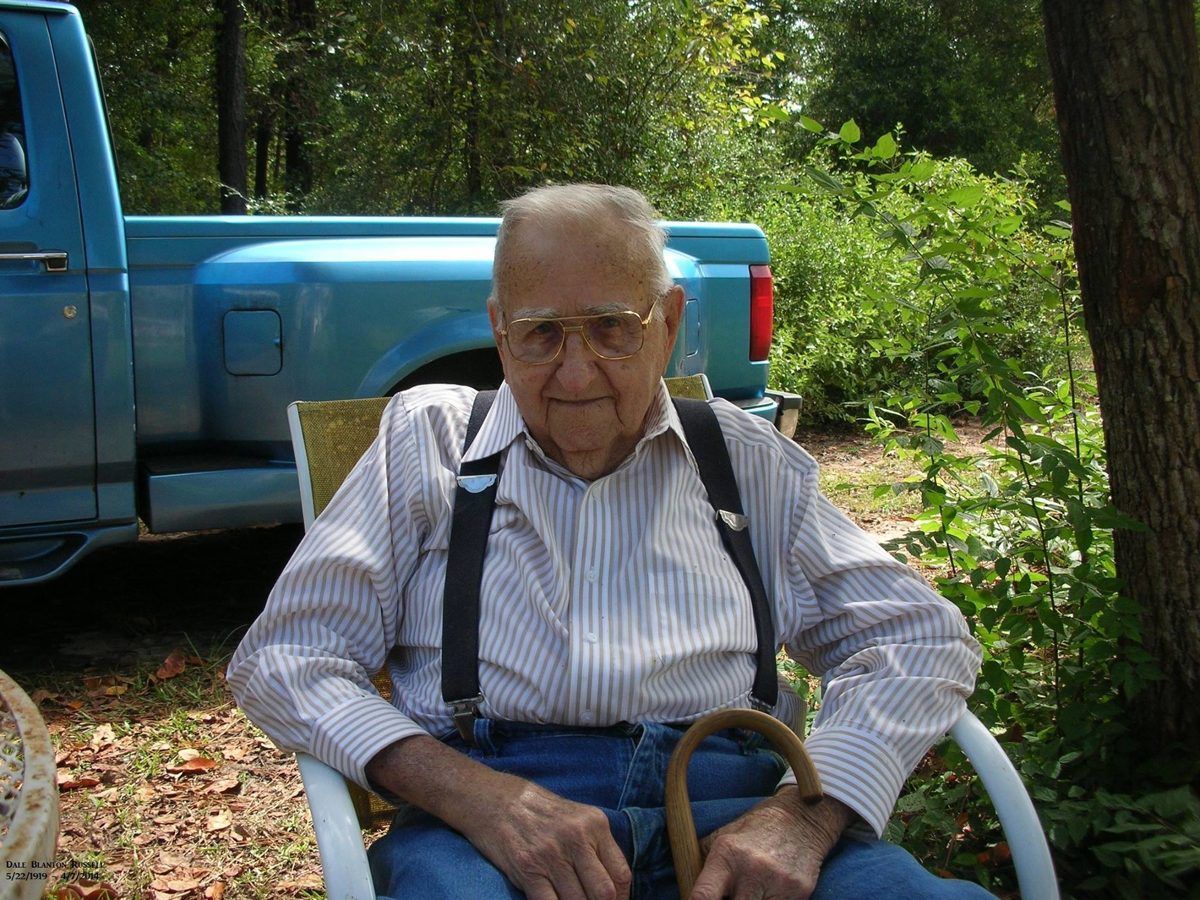
Dale Blanton Russell (1919–2014), Eli and Leah’s youngest, in his later years. Family photo.
A Piney Woods girl goes to college
Lillian Russell, ballplayer and schoolteacher
Lillian went barefoot to school and hid her shoes behind a log. When the 1918 flu came through Oak Flat she was 15, and she nursed sick neighbors day and night. She played on the Huntington girls’ basketball team in bloomers, finished high school in 1920 at 17, and in 1921 went off to Sam Houston Normal in Huntsville, where she picked up the nickname “Diddie.”
From 20 on she taught in one- and two-room country schools at Oak Flat, Ora and Etoile, across the Angelina River from Huntington, and took summer courses at Stephen F. Austin in Nacogdoches and Southwest Texas in San Marcos. Her teaching pay helped hold the Russell family up. Winnie wrote that a calf or pig named as a child’s own, with the sale money set aside for that child, may have helped pay her way. Lillian kept studying, and earned a degree from McNeese in 1954.
Sources: Winnie Graham, Under the Blackgum Tree: 165 Years in the Piney Woods (Nacogdoches: Stephen F. Austin State University Press, 2013), pp. 80–83, 98–107.
The engineer
Fred Graham and the Lufkin pumping unit
Fred Graham was born in Buffalo, New York, to Scottish parents and grew up in Norfolk, Virginia. Orphaned young, he worked his way west in steps: a cattle boat to England and back, jobs along the Atlantic coast, a stint in Detroit. In San Francisco he saved a burning shop by shutting off the gas, and his boss let him work nights so he could study engineering at the University of California. He came to Texas for Hughes Tool and then went to work for Lufkin Foundry and Machine Co., where he stayed more than 20 years.
He met Lillian Russell on the Ferris wheel at the Lufkin county fair, and they married on Christmas Eve 1929 at the First Christian Church parsonage in Lufkin, with a honeymoon in Galveston.
Winnie wrote that whenever you see “Lufkin” on the walking beam of an oil pump anywhere in the world, you should think of her father. The record backs her up, with one correction. The foundry’s famous counterbalance crank was W. C. Trout’s invention. But Fred Graham of Lufkin has his own patent: a straight-line pumping jack, filed in 1935 and granted in 1936, assigned to Lufkin Foundry and Machine Co.
1930s Lufkin
Growing up a foundry engineer’s daughter
Before he ever got to Texas, Fred had lost his savings in an Iowa bank failure and worked in Detroit, as he liked to say, as an “industrial spy” on headlight magnetos. When he married Lillian, Winnie wrote, he gained 64 first cousins.
Winnie grew up in Lufkin. She walked to the Coca-Cola plant to watch the bottles go by the window and gazed at the big houses on Raguet Street that sawmill fortunes built. Fred and Lillian golfed at the country club (Lillian placed in tournaments) and bowled, and Lillian belonged to the church fellowship, a book club, the garden club and a bridge club.
Hard times
In the Depression a man could earn a dollar a day splitting railroad ties. Country folks sold their produce door to door in Lufkin, musicians strolled the streets, and hobos got fed on the back stoop. Aunt Addie said the Depression didn’t change much for them: they’d always been poor and grew everything they ate.
Sources: Winnie Graham, Under the Blackgum Tree: 165 Years in the Piney Woods (Nacogdoches: Stephen F. Austin State University Press, 2013), pp. 26, 112–125.
Trips
A tourist cabin at Rockport. Houston’s Rice Hotel cafeteria and Foley’s. Easter eggs hidden on the bank by the Neches River bridge on the way to Tyler County, and Sunday visits out to Grandma and Grandpa’s near Huntington.
Sources: Winnie Graham, Under the Blackgum Tree: 165 Years in the Piney Woods (Nacogdoches: Stephen F. Austin State University Press, 2013), pp. 124–139.
Christmas 1939
The whole family gathered in front of Fred and Lillian’s Lufkin house for a picture: Grandma and Grandpa Russell, Aunt Mary and Uncle Kyle, Uncle Dale and Aunt Jewel, and the children.
Sources: Winnie Graham, Under the Blackgum Tree: 165 Years in the Piney Woods (Nacogdoches: Stephen F. Austin State University Press, 2013), p. 185.
Summers at Oak Flat
Barefoot from spring to November
Summers meant Oak Flat: plowing, picking black-eyed peas, digging sweet potatoes, and swimming in the stock tank after checking it for water moccasins. Children went barefoot from spring until November and played with cornhusk dolls and paper dolls cut from the Sears catalog. A peddler came through the settlement every week.
Aunt Addie and Uncle Jack
Winnie rode her horse Nellie over to their place. They slept on goose-down mattresses, and once found a rattlesnake coiled in the bedsprings. Aunt Addie lived to 91 and Uncle Jack to 89, and they died within months of each other in 1968. In her last house Aunt Addie decorated a lilac that wouldn’t bloom with lilac pictures cut from a catalog.
Sources: Winnie Graham, Under the Blackgum Tree: 165 Years in the Piney Woods (Nacogdoches: Stephen F. Austin State University Press, 2013), pp. 152–177.
The Pine Grove
A few acres of big pines on a slope beside the road from Huntington to Oak Flat, the ground soft with pine straw. It was the family’s picnic spot.
Sources: Winnie Graham, Under the Blackgum Tree: 165 Years in the Piney Woods (Nacogdoches: Stephen F. Austin State University Press, 2013), ch. 19.
Grandma Wade’s ride
In her 80s, Grandma Wade rode on the back of a grandson’s motorcycle, a German Army machine he’d brought home from the war.
Sources: Winnie Graham, Under the Blackgum Tree: 165 Years in the Piney Woods (Nacogdoches: Stephen F. Austin State University Press, 2013), pp. 178–188.
Leah’s ride
As a teenager, Grandma Leah forded a flooded creek on horseback rather than miss a social.
Sources: Winnie Graham, Under the Blackgum Tree: 165 Years in the Piney Woods (Nacogdoches: Stephen F. Austin State University Press, 2013), pp. 60–69.
Grandpa and the boar
Out in the open-range woods a wild boar once went after Grandpa, and his dog saved him.
Sources: Winnie Graham, Under the Blackgum Tree: 165 Years in the Piney Woods (Nacogdoches: Stephen F. Austin State University Press, 2013), pp. 24–25.
Lillian’s letters
Lillian kept a packet of Fred’s love letters and the gifts he gave her. When Winnie wrote the book, she and her brothers still had them.
Sources: Winnie Graham, Under the Blackgum Tree: 165 Years in the Piney Woods (Nacogdoches: Stephen F. Austin State University Press, 2013), pp. 112–123.
Huntington people
Aunts, uncles and the town
Winnie’s aunts and uncles show up all over Huntington’s history. Here’s who they were, as she remembered them.
Grandpa’s brother
Uncle Bud, lumberman
Earl Jackson Russell started logging as a teenager, became a lumber inspector across the Southern timber belt, worked for the Southern Pine Association in Washington, D.C., through World War II, logged mahogany in Honduras, and came home to Oak Flat in the mid-1950s.
Sources: Winnie Graham, Under the Blackgum Tree: 165 Years in the Piney Woods (Nacogdoches: Stephen F. Austin State University Press, 2013), pp. 28–41.Grandpa’s brother
Uncle Thedford, constable
Thedford Russell served several terms as constable in Huntington. He and his brother Jimmy hand-dug a well with shovels, buckets, a rope and a pulley.
Sources: Winnie Graham, Under the Blackgum Tree: 165 Years in the Piney Woods (Nacogdoches: Stephen F. Austin State University Press, 2013), pp. 164–177.Lillian’s sister
Aunt Mary, Mary’s Place
Mary Katherine worked local cafés, ran the bus station café, and then had her own: Mary’s Place in Huntington. Her husband Kyle drove road-crew bulldozers and served as a Forest Service fire-tower lookout.
Sources: Winnie Graham, Under the Blackgum Tree: 165 Years in the Piney Woods (Nacogdoches: Stephen F. Austin State University Press, 2013), pp. 124–139.Grandpa’s sister’s husband
Uncle Josh, stationmaster
Trains stopped at Huntington from the early 1900s until after World War II to load cotton bales and cattle and unload groceries. Winnie remembered Uncle Josh as the stationmaster, living in the railroad’s mustard-yellow house across a lane from the depot.
Sources: Winnie Graham, Under the Blackgum Tree: 165 Years in the Piney Woods (Nacogdoches: Stephen F. Austin State University Press, 2013), pp. 159–160.Grandma Wade’s son-in-law
Uncle Merrill, the doctor
Dr. Merrill Rogers doctored through the 1918 flu and was often paid in eggs, sweet potatoes and quilt tops. One family paid him with a fine concert violin. He traded it to Grandpa Eli for two hams at hog killing, “the violin became a fiddle,” and it stayed in the family.
Sources: Winnie Graham, Under the Blackgum Tree: 165 Years in the Piney Woods (Nacogdoches: Stephen F. Austin State University Press, 2013), pp. 70–83, 124–139.The neighbors
Oak Flat’s music
Aunt Winnie played piano for silent movies. Uncle Jack’s “Sally Goodin” could be heard at the far end of the cornfield. Instead of dances, young folks played singing games like “Skip to My Lou.”
Sources: Winnie Graham, Under the Blackgum Tree: 165 Years in the Piney Woods (Nacogdoches: Stephen F. Austin State University Press, 2013), pp. 138–151.
1940s
The war years
In World War II, Lufkin Foundry put up chain-link fences and guardhouses and went to war work alongside its pumping units. Workers wore photo badges. Young Winnie had a badge of her own and a little drafting table next to her father’s.
The Angelina National Forest ran right up against part of Grandpa Eli’s cornfield. In 1944 the Army opened a prisoner of war camp at the Lufkin fairgrounds, and German prisoners were put to work salvaging timber. Winnie remembered farmers visiting with prisoners across the fence while they worked the woods next to Grandpa’s corn.
Then came what Winnie called the Great Dispersal: families leaving the Piney Woods for war jobs on the coast. The Grahams went to Houston, Corpus Christi and Lake Charles. Grandpa couldn’t find corn seed at home in the war years, so Lillian bought it at a Houston seed store and sent it back. Many families came home again. Some made their last trip home to Jonesville Cemetery.
Sources: Winnie Graham, Under the Blackgum Tree: 165 Years in the Piney Woods (Nacogdoches: Stephen F. Austin State University Press, 2013), pp. 178–188; Texas Historical Commission marker 13709, “German POWs in the East Texas Timber Industry” (2006): Camp No. 2 at the county fairgrounds, late April to September 1944, 500 prisoners salvaging ice-damaged timber, via the Texas Historic Sites Atlas.
Where they rest
Jonesville Cemetery and the stone log
Jonesville, about three miles southeast of Huntington, was Angelina County’s seat of government from 1854 to 1858. The town is gone. The cemetery isn’t.
James Eason Russell (1824–1903) and Caroline Welch Russell (1826–1894), Grandpa Bill’s parents, are buried there. Their marker is a petrified log. Uncle “Dock” found it in the woods and had it hauled to the cemetery by log cart, and it lies across the head of both graves. Winnie called it the most prominent marker in the cemetery. Grandpa Eli and Grandma Leah lie there side by side, and Grandma Wade is there too.
Sources: Winnie Graham, Under the Blackgum Tree: 165 Years in the Piney Woods (Nacogdoches: Stephen F. Austin State University Press, 2013), pp. 28–30, 189–191; Bob Bowman, ed., Land of the Little Angel: A History of Angelina County, Texas (Lufkin: Lufkin Printing Co., 1976), pp. 143–144, 277–278.
Every family cemetery in these woods sits on ground somebody else may one day want for a pipeline, a reservoir or a plant site. Graves have been moved for Sam Rayburn Reservoir, and one pioneer family cemetery ended up inside a pipeline pump station. See Lost to the lake and the old cemeteries.
Family treasures
What the family kept
Winnie wrote about the things that came down through the family. If your family has old things like these, the stories behind them are worth writing down while somebody still knows them.
The amber glass shoe
A neighbor brought little Leah a tiny button-and-daisy glass shoe full of candy. Lillian later slipped it on each new baby’s foot.
The hymnal
Grandma Leah’s 1947 Pentecostal Praise Hymnal, 65 cents, printed in shape notes. The family funeral hymn was “When They Ring the Golden Bells.”
The memory books
Lillian’s school memory book, filled to the back cover with friends’ verses, and her 1919 Spanish textbook.
The mattress needles
Grandpa kept the needles from the New Deal cotton mattress program in a leather case under the eaves of the gal’ry.
Sources: Winnie Graham, Under the Blackgum Tree: 165 Years in the Piney Woods (Nacogdoches: Stephen F. Austin State University Press, 2013), pp. 61–67, 98–107, 140–149.
Read the book
Under the Blackgum Tree: 165 Years in the Piney Woods by Winnie Graham (Stephen F. Austin State University Press, 2013; ISBN 978-1-62288-022-5). We’ve only scratched the surface here. Ask for it at your library or bookstore.
Got a family like this one? We’d love to tell your people’s story too. Write contact@grailsystems.io. We’ll ask before we post anything, and we never post private family matters.