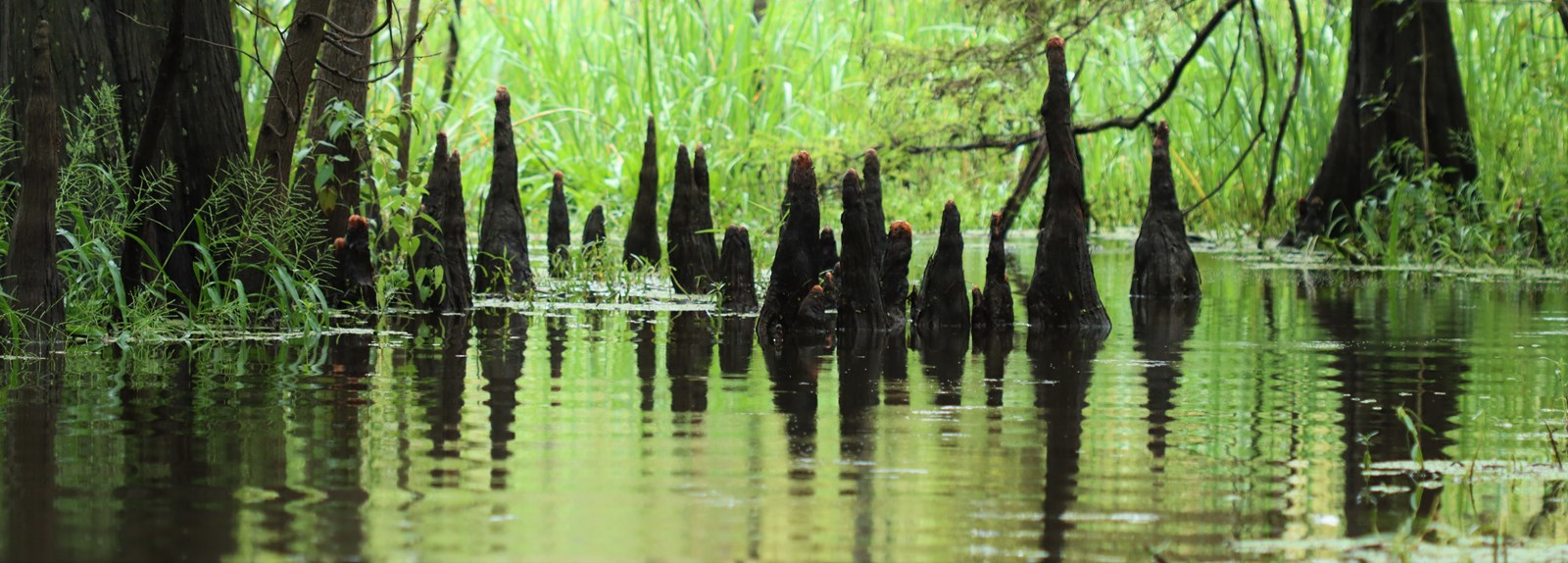
Water ran the first mills
One of the county’s early mills ran on the water of Mill Creek. The county history names Berry Roberts, an enslaved man, as one of the people who worked it. Some of the county’s first industry ran on water power and enslaved labor.
Sources: Bob Bowman, ed., Land of the Little Angel: A History of Angelina County, Texas (Lufkin: Lufkin Printing Co., 1976); see also our Mill Creek page.When the Angelina carried boats
From the 1840s, steamboats and barges hauled cotton down the Angelina and Neches. The Laura ran from Brown’s Ferry in Angelina County to Sabine Pass. The county history says the river carried less water as farmland spread and the springs that fed it were plowed under, and boats got stranded in low water. River commerce faded once the railroads came.
Sources: Bob Bowman, ed., Land of the Little Angel: A History of Angelina County, Texas (Lufkin: Lufkin Printing Co., 1976).A town born at a spring
Lufkin began at a crossroads called Denman Springs, where the railroad arrived in 1882. When the town incorporated in 1890, its legal boundary was drawn from “the head of Brushy Creek” and from Denman Spring. The springs came first; the town was drawn around them.
The county history dates the first part of Lufkin’s waterworks to 1891, with a storage tank called “the standpipe” in the middle of Cotton Square, and credits Mayor T. C. Mantooth’s time with the first waterworks system. A city engineer, P. A. McCarthy, later built the sewer system. A town’s water is public business from day one.
Sources: Bob Bowman, ed., Land of the Little Angel: A History of Angelina County, Texas (Lufkin: Lufkin Printing Co., 1976), pp. 25, 152–153, 285, 290.A forest to protect the watershed
The Angelina National Forest was proclaimed in October 1936. The federal law behind national forests in the East, the 1911 Weeks Act, let the government buy forest and cut-over land in the watersheds of navigable streams to protect their flow. Protecting water was part of the reason our national forests exist.
Sources: 16 U.S.C. 515 (Weeks Act of March 1, 1911); U.S. Forest Service, National Forests and Grasslands in Texas.A river authority is born
In 1949 the Legislature split the old Sabine-Neches Conservation District, creating the Neches River Conservation District. In 1977 it was renamed the Angelina & Neches River Authority. It’s still headquartered in Lufkin.
Sources: Angelina & Neches River Authority, “History”.A countywide water district, on paper
In 1957 the county commissioners created Angelina County Water Control and Improvement District No. 2, covering about 640,000 acres, more than the 514,368 acres in the whole county. A smaller WCID No. 1 was created in 1958 and later dissolved. The 1976 county history doesn’t say what No. 2 ever did. Does it still exist, and what powers does it hold? That’s a question for a records request.
Sources: Bob Bowman, ed., Land of the Little Angel: A History of Angelina County, Texas (Lufkin: Lufkin Printing Co., 1976), pp. 181, 193.Rayburn was built to store water for industry
The U.S. Army Corps of Engineers built Sam Rayburn Reservoir from 1956 to 1966. Its stated purposes were hydroelectric power and storing water for cities and industry. The Lower Neches Valley Authority, based downstream near Beaumont, held a contract to buy water from it.
So the largest lake built entirely inside Texas wasn’t built only for fishing and boating. From the start, it was a water bank, and downstream industry held an account.
Sources: Bob Bowman, ed., Land of the Little Angel: A History of Angelina County, Texas (Lufkin: Lufkin Printing Co., 1976); Lower Neches Valley Authority (founded 1933).Who holds the account today?
The same questions apply now: who has rights to Rayburn water, who’s pumping our aquifer, and who decides. See Good water and our drawdown page for what we’re watching.
Sources: Our own records requests and water pages.About our sources
Much of this page comes from Land of the Little Angel, the 1976 county history edited by Bob Bowman. We retell it in our own words and point you to the book; we don’t reprint it. Kurth Memorial Library in Lufkin keeps a copy. Know something we got wrong, or have a family story that belongs here? Write contact@grailsystems.io.