The mayhaw slough down by the creek, the persimmon on the fence row, the chanterelles after a summer rain. These are the wild foods of Deep East Texas, and the plants and mushrooms that can hurt you if you mistake them for one.
Read this first. This page is for learning and for honoring what our people knew. It is not a field guide. Never eat a wild plant or mushroom because a website says it’s safe, this one included. Have someone who knows confirm it in person, every time. Many edible plants and mushrooms have poisonous look-alikes, and some of those can kill.
If someone eats something and you’re not sure what it was, call the Texas Poison Center Network right away, any hour of any day. Don’t wait for symptoms; with some mushrooms they take hours to show. In an emergency, call 911.1-800-222-1222
The year in the woods
When each one is ready, as far as our sources say. Where a source gives a season but not months, we wrote it out instead of guessing.
Our grandparents picked where they had permission to pick, and the rules still matter.
Private land: get the owner’s OK first.
Texas state parks: picking or removing any plant life without a permit from the director is an offense under state park rules.
Big Thicket National Preserve: you may gather a reasonable amount for personal use from a set list: pawpaw, mayhaw, wild grape, wild strawberry, wild blueberry, wild huckleberry, blackberry, dewberry, mulberry, walnut, pecan and hickory nuts. Carry no more than a one-quart container home, and sell none of it. Mushrooms are not on the list.
Angelina, Davy Crockett, Sabine and Sam Houston National Forests: check with the ranger district before you gather anything.
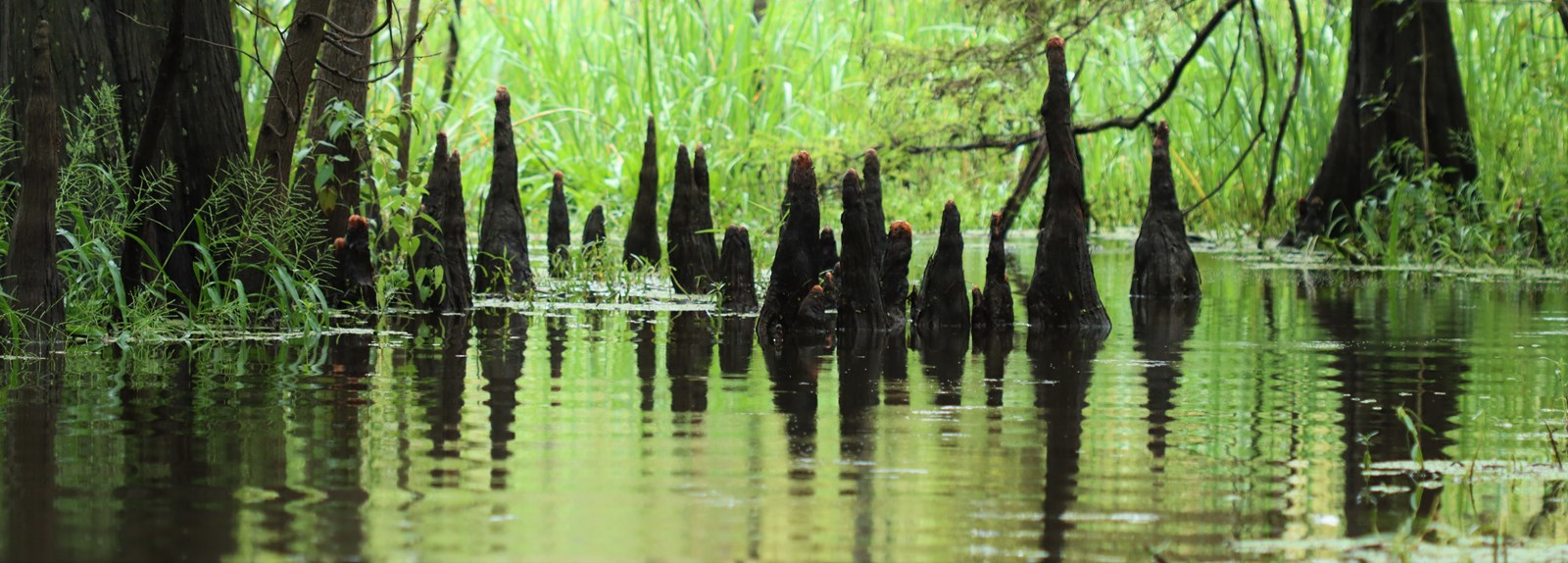
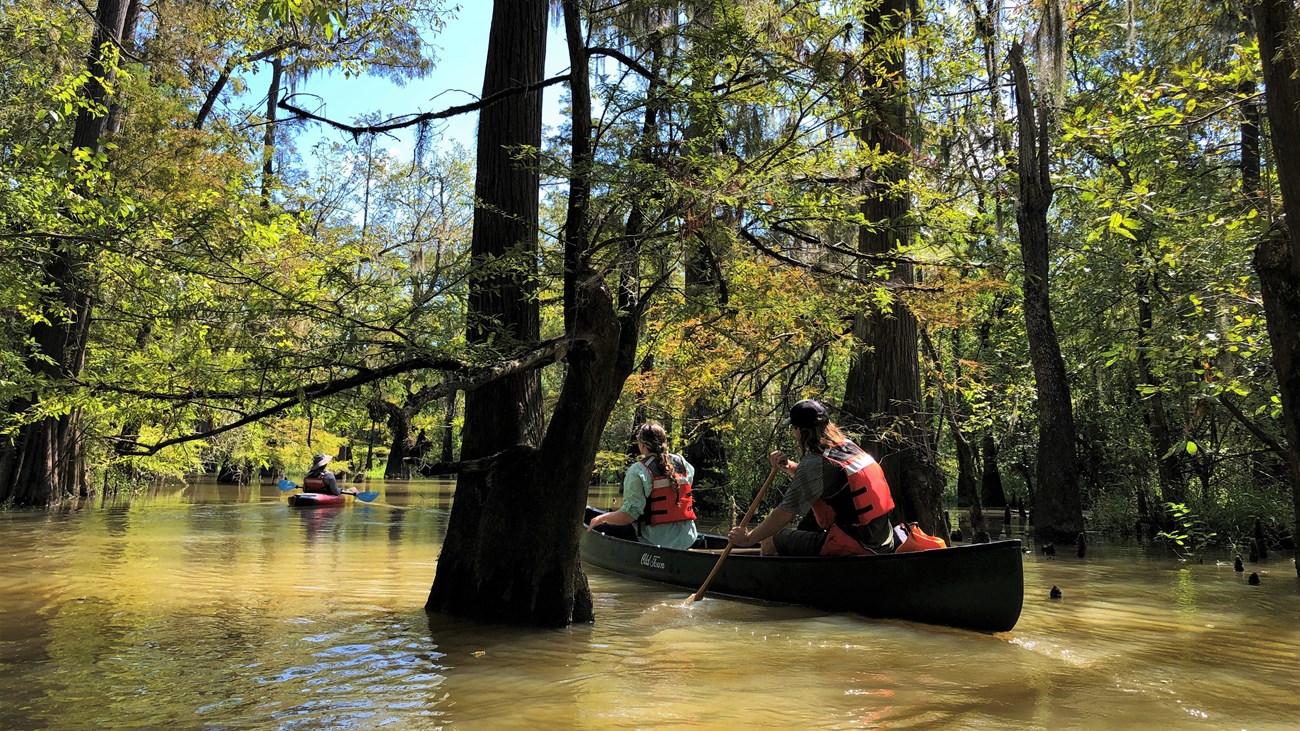
The taste of Deep East Texas. Small, tart, apple-like fruit from a thorny hawthorn that grows in wet bottomland along our creeks and rivers. In Texas, mayhaws grow only north and east of the Trinity River. They bloom white in February and drop ripe fruit in late April and early May, often right into the water.
Dewberries are wild blackberries on a low, trailing vine. Southern dewberry grows from East through Central Texas along roadsides, fence rows and thickets, and bears heavily in spring and early summer. Jesse Truvillion remembered picking blackberries in the Big Thicket for pie, and for wine for the Lord’s Supper.
Our native grape. Muscadines grow wild from the eastern third of Texas, where the soil is acidic and rain is heavy, east to Maryland. They hang in small clusters of big berries that ripen one at a time and drop when they’re ready. Wild vines are male or female, so only some bear fruit.
When: most muscadines ripen from mid-August through September in East Texas.How we eat it: fresh, or as jelly, jam and wine. The seeds are hard and often bitter.
Muscadine
Several small, round seeds. Curling tendrils. Toothed leaves.
Common moonseed
Poisonous. Blue-black berries in grape-like clusters, ripe about the same time. One flat, crescent-moon seed. No tendrils; leaves not toothed.
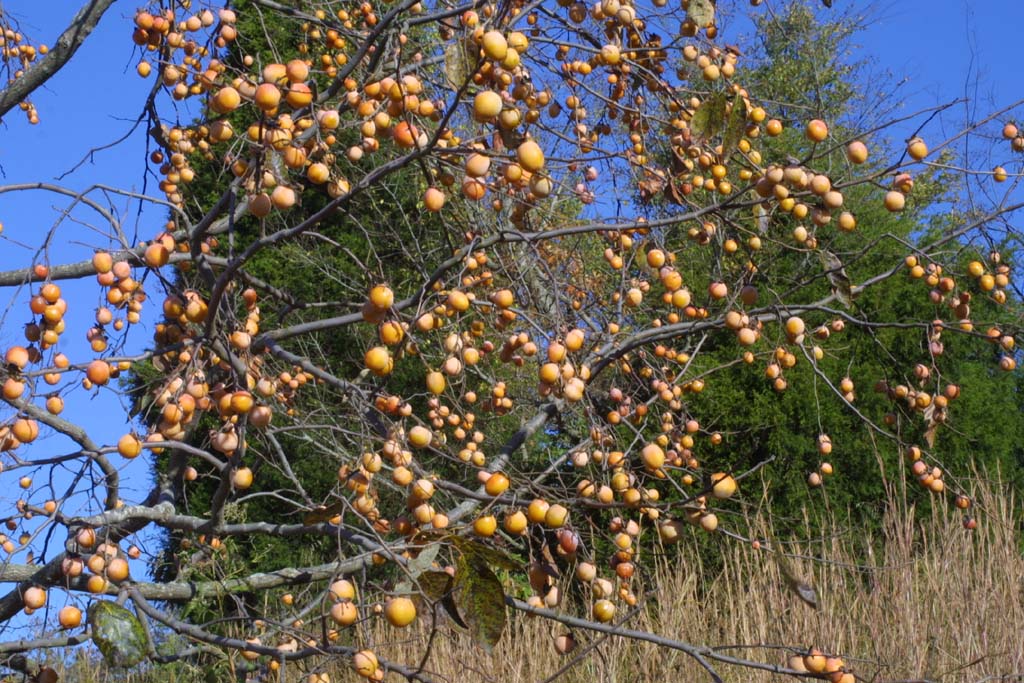
The “possum apple.” American persimmon grows wild across the South and west into Texas as far as the Colorado River, often in groves along fence rows and old pastures. Its range takes in the Caddo homeland too.
When: usually after the first frost, once the leaves have fallen.How we eat it: only when soft and fully ripe. An unripe persimmon is so astringent it will pucker your whole mouth, and even after frost some fruit stays that way.
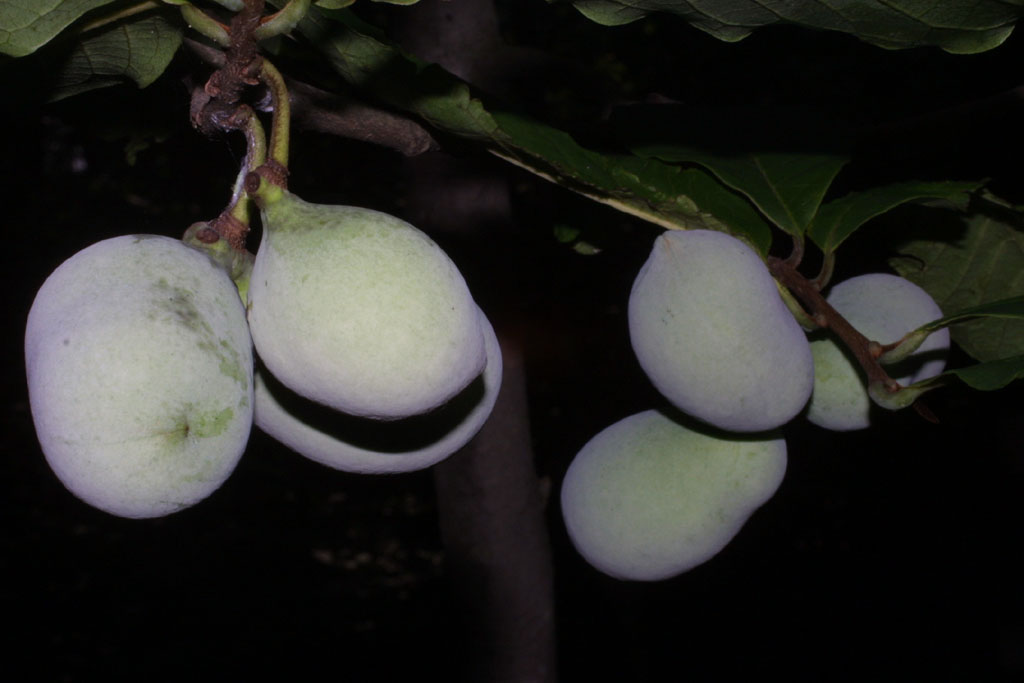
The largest edible fruit native to the United States. Pawpaw grows in thickets along stream banks and in rich, damp bottomland woods, and its range reaches south into eastern Texas.
When: blooms April to May; the fruit ripens later in the year.Take care: handling the fruit can irritate skin, and some people get bad stomach and intestinal pain from eating it. Try a little first.
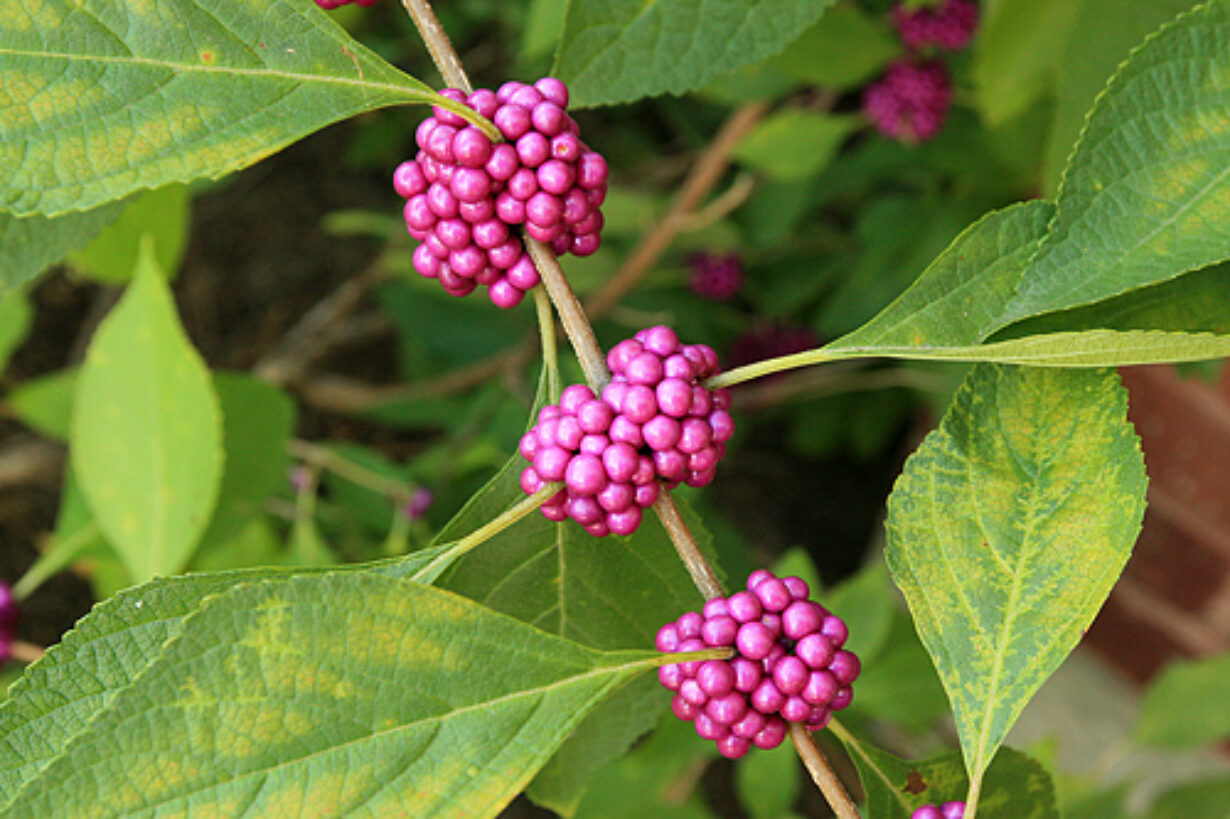
A native shrub of the Southeast with bright purple berry clusters. The berries are edible, but raw they’re mealy and bland. Cooked into jelly, they’re a different story. Delena Tull’s Edible and Useful Plants of Texas and the Southwest says the later in the season you pick them, the better.
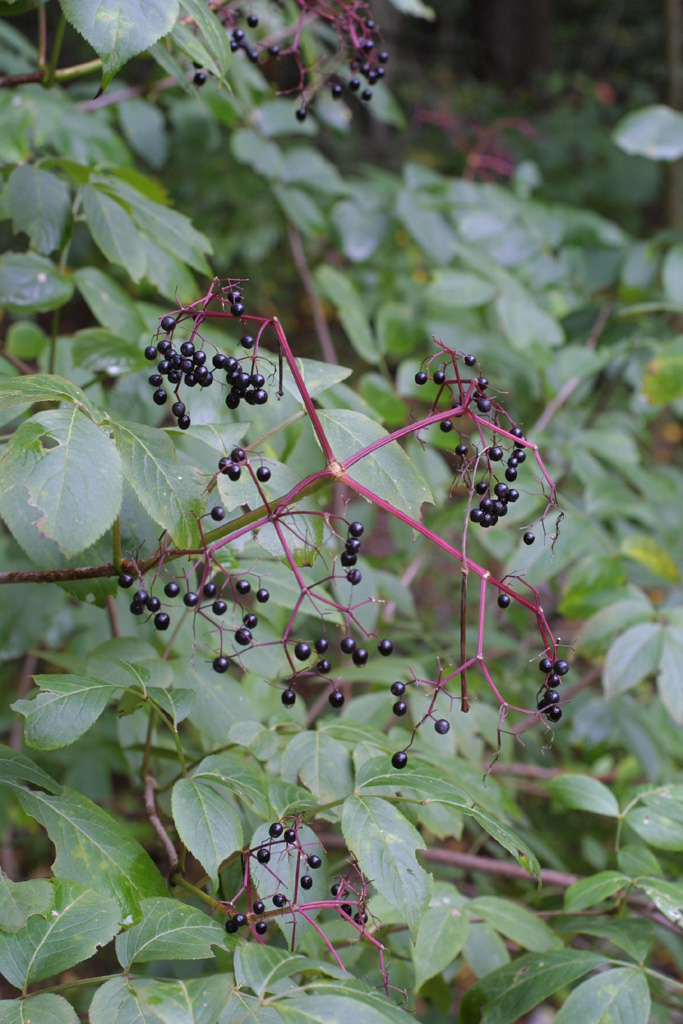
A shrub of wet ground along fence rows, streams and low places in East Texas, with flat clusters of white flowers and then dark berries.
How we eat it: the ripe berries, always cooked. The leaves, stems and roots are poisonous, and raw or unripe berries can make you sick. Pick off every stem.
Elderberry
A woody shrub with white flower clusters, then dark berries.
Spotted water hemlock
Deadly. Same wet ground, often right beside elderberry, with the same kind of white flower clusters. Smooth, hollow, soft stems, often streaked purple. More below.
Prunus species, including Chickasaw plum (P. angustifolia)
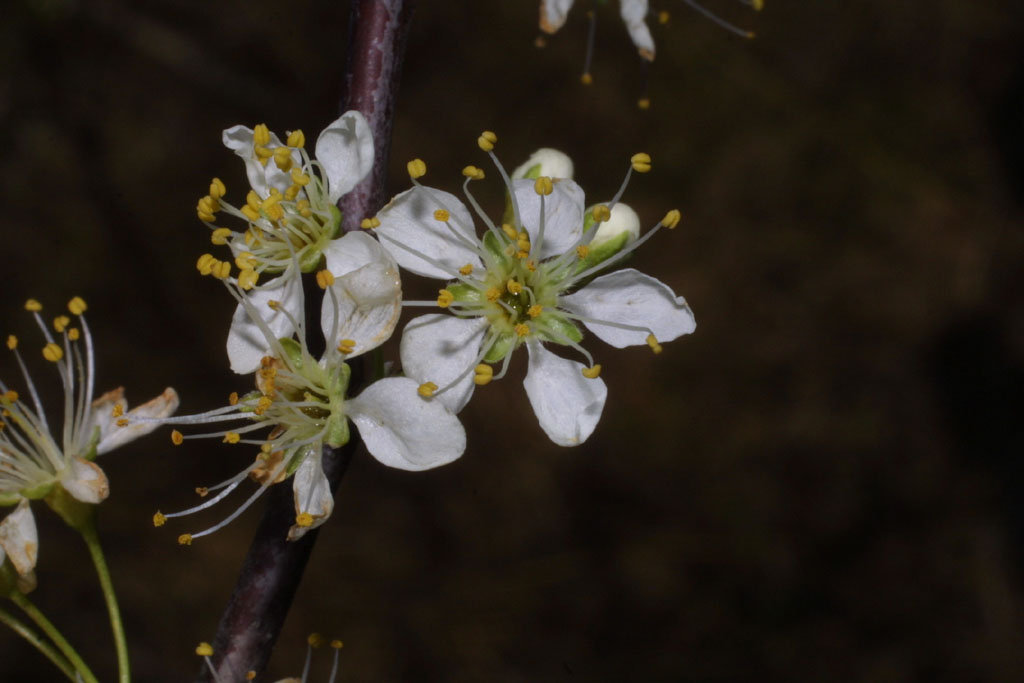
Winnie Graham wrote that her grandfather could walk straight to the wild plums in the Oak Flat woods without a trail. Chickasaw plum, one of the native wild plums of Texas, grows into thorny thickets with fragrant white flowers in spring. Some trees bear good fruit and some bear very bitter fruit, so not every tree is worth the picking.
When: Chickasaw plums fruit from June into August.How we eat it: fresh, or as jam and jelly. Its fruit has long been made into wine, jam and jelly.
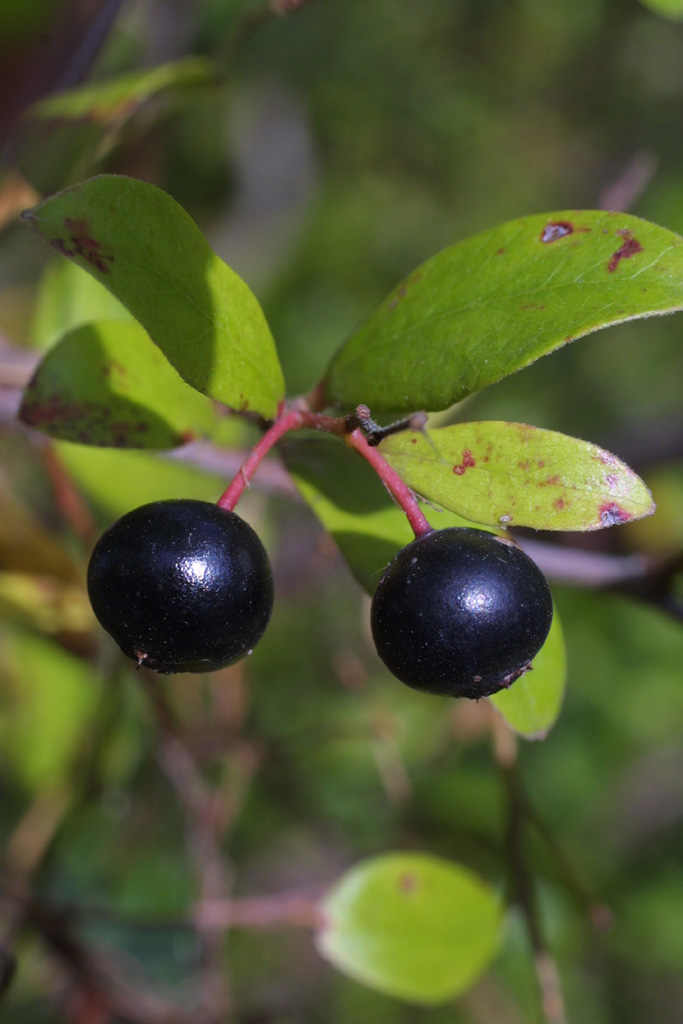
A wild blueberry that grows into a small tree, also called sparkleberry, tree huckleberry and winter huckleberry. In 1976 the national champion farkleberry stood near Zavalla, 29 feet tall, in the creek country of Sandy, Turpentine, Shawnee and Possum Walk creeks. You can see one at the Pineywoods Native Plant Center in Nacogdoches.
When: the shiny black berries ripen in fall and hang on through winter.How we eat it: fresh. They're edible and sweet, but dry and mealy, and some bushes taste better than others.
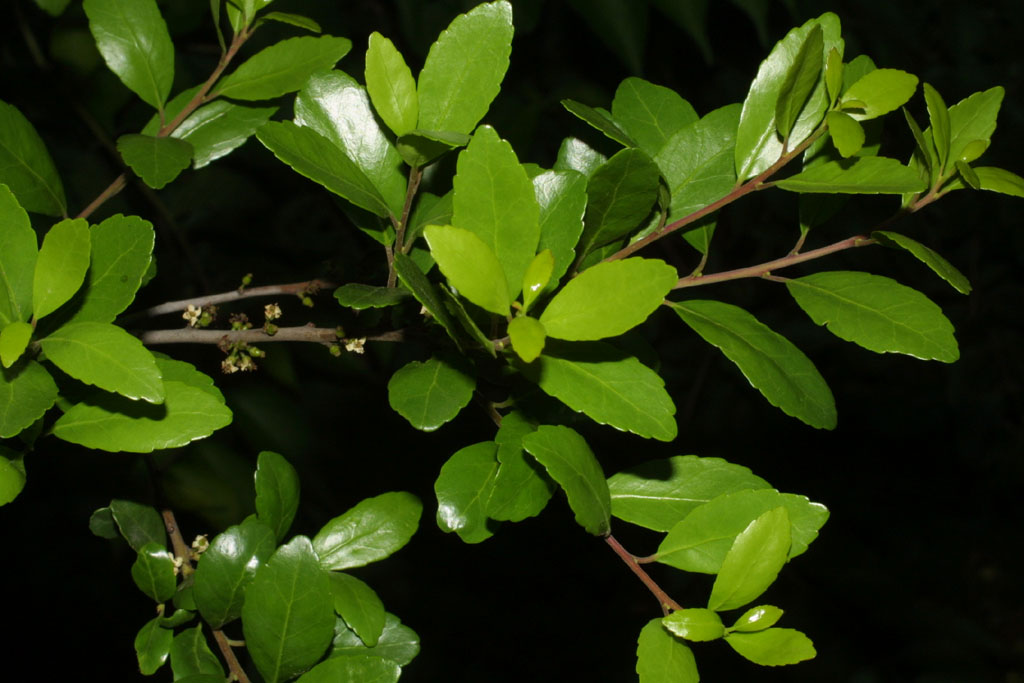
The evergreen holly that grows all through the East Texas woods. It's the only plant native to North America with caffeine in it, and Native peoples across the Southeast brewed its leaves. Despite the name, a tea of the leaves can be safely drunk. At Oak Flat, country folks hung a sprig of it, red berries and all, for Christmas.
How we use it: dried leaves, brewed as tea.Take care: the red berries are toxic to people. Birds can eat them; you can't.
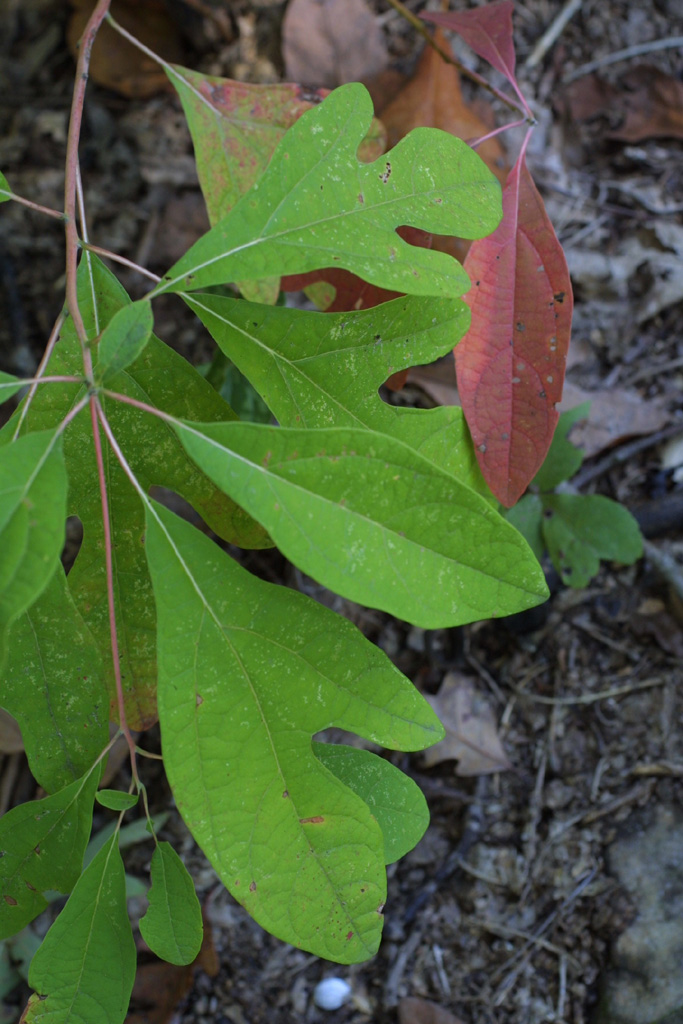
A native tree of the eastern United States. Its dried, ground young leaves are filé powder, the seasoning and thickener stirred into gumbo after it comes off the heat.
How we use it: leaves, dried and ground into filé.Take care: the old root-bark tea is a different story. Sassafras root bark and oil are high in safrole, which the FDA has banned as a food additive over cancer concerns. Skip the root tea.
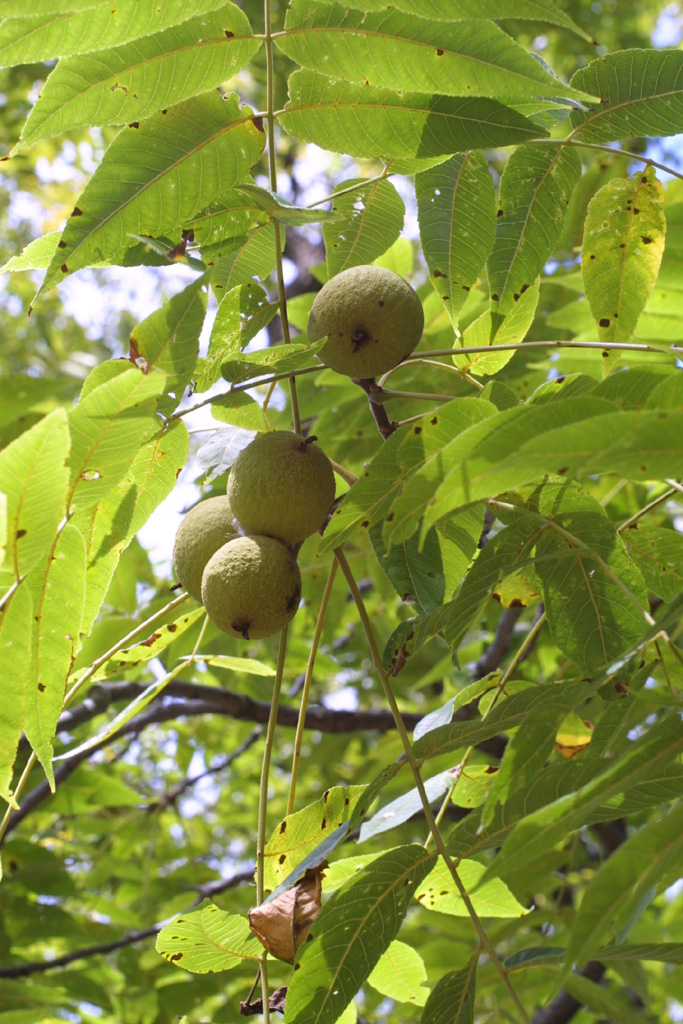
Pecans are native from Indiana and Illinois south to Louisiana and Texas. Hickory nuts were a common thing to gather in the Big Thicket, and pecan, hickory and walnut are all on the preserve’s list of foods you may gather for personal use.
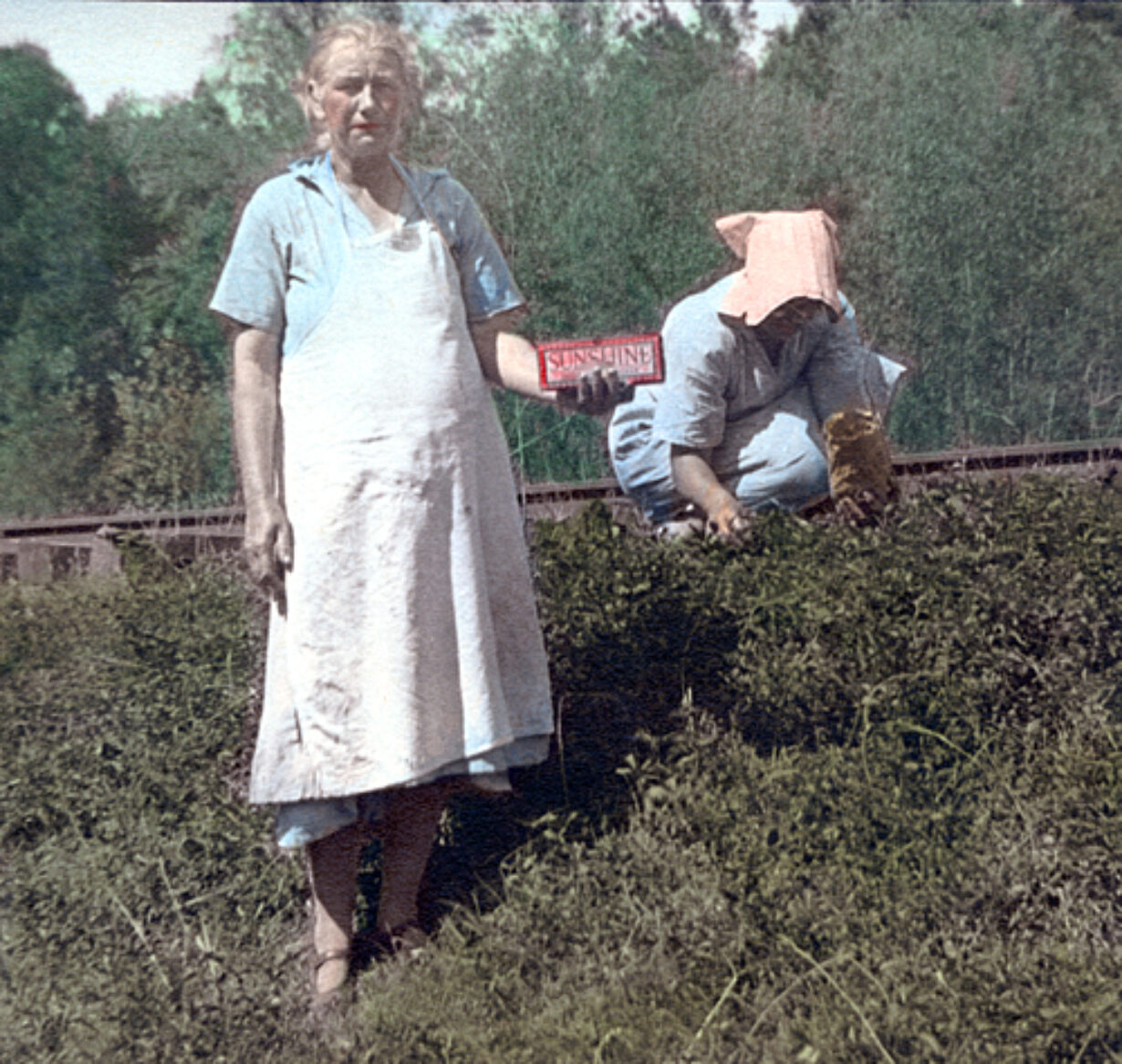
Della Burchfield and Gertrude Waltman White picking berries along the railroad near Fastrill, 1935. A hand-tinted print. Courtesy of The History Center, Diboll, Texas.
Leave these alone
These grow in our part of Texas. Learn them before you learn anything else.
Spotted water hemlock
Cicuta maculata
Deadly. The most toxic plant in North America, and every part of it is deadly. A piece of root the size of a walnut can kill an animal the size of a cow. In Texas it grows in the east, center and north of the state, always near water: streams, marshes, wet meadows and springs. It has white umbrella-shaped flower clusters and smooth, hollow stems often streaked purple, and it can be mistaken for wild carrot (Queen Anne’s lace) and elderberry.
Poisonous. Tall, with reddish-purple stems and drooping clusters of dark purple berries. It grows in the eastern two-thirds of Texas, often in disturbed sandy ground and old brush piles. The berries and roots are poisonous to people. People have long eaten “poke sallet,” young leaves boiled with the water changed to carry off the toxins, but Mississippi State Extension considers every part of the plant toxic. We don’t recommend it.
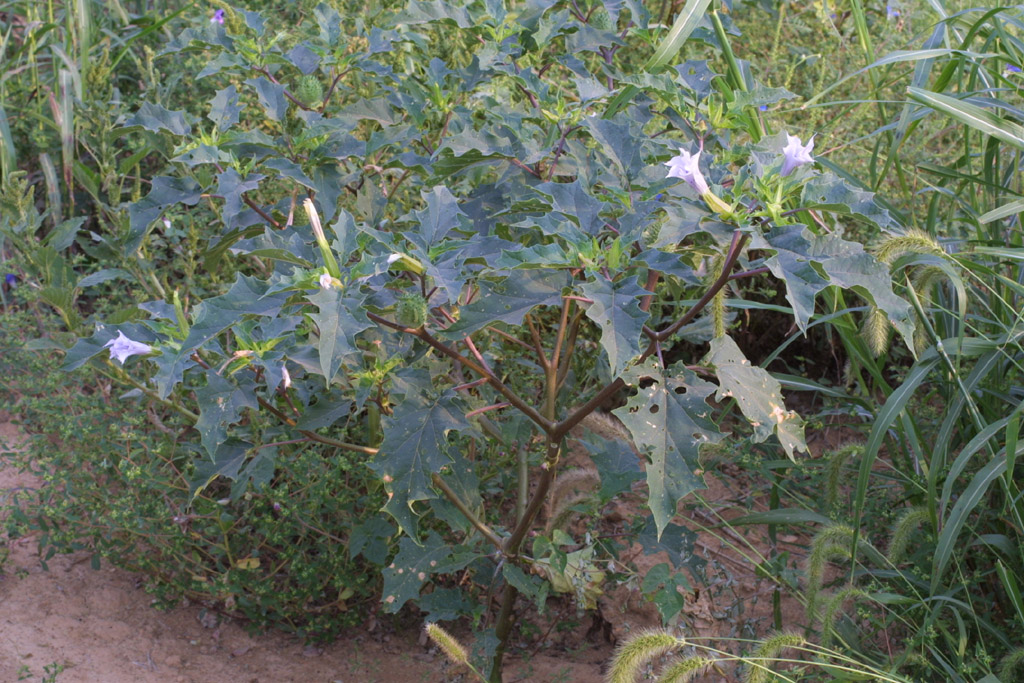
Poisonous, every part. A coarse, bad-smelling weed with big white to purple trumpet flowers and a spiny seed pod. Several kinds grow in Texas, including the Pineywoods. The leaves and seeds carry the most poison, the same drugs as atropine and scopolamine. In 1676 soldiers at Jamestown ate it boiled as greens, and it's been called Jamestown weed ever since. Don't confuse it with angel's trumpet, which is just as dangerous: jimsonweed flowers point up, angel's trumpet flowers hang down.
Poisonous, every part. The yellow trumpet-flowered vine that lights up our woods and fence rows in late winter and early spring, the "yellow jasmine" Winnie Graham remembered in March. Every part carries toxins related to strychnine. Children have been poisoned by sucking the nectar from the flowers, so teach yours to leave it be.
Poisonous. Not a strawberry. Also called hearts-a-bustin'. In fall its warty pink-red pods look a little like strawberries, then split open on bright orange-red seeds. The fruit, seeds and bark are poisonous, and the seeds are a harsh laxative. Winnie Graham wondered if it was the "strawberry" of an old song; it's a pretty plant, but not one to eat.
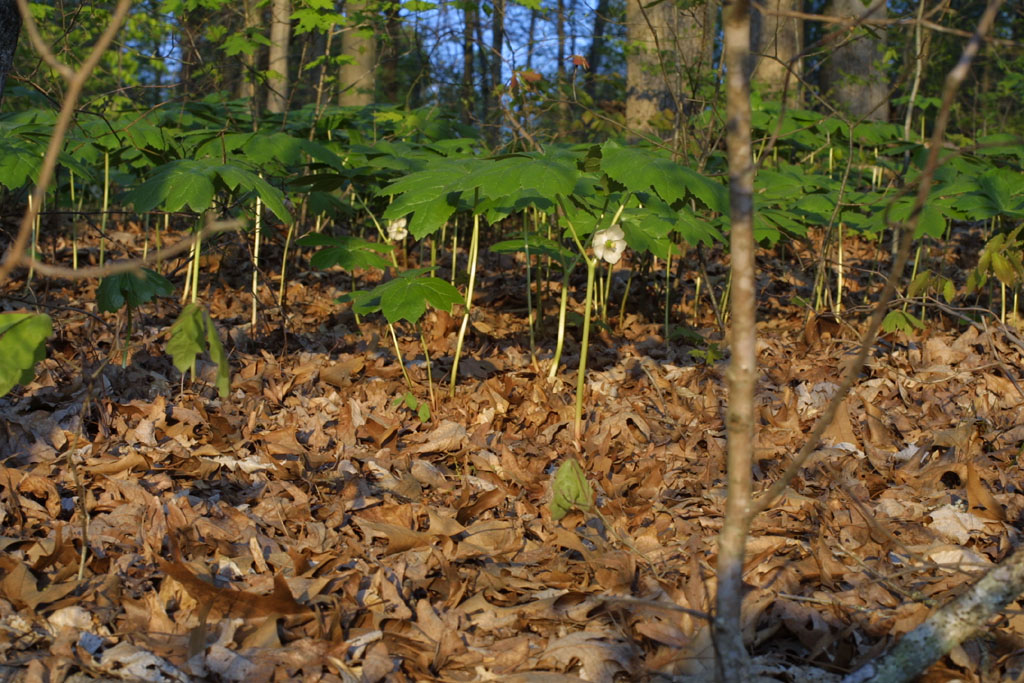
Poisonous, except one part, and only just. Umbrella-shaped leaves in colonies on the forest floor. Every part is poisonous except the fully ripe, soft, yellow fruit, and even that is safe only in small amounts. The green fruit, leaves and roots are toxic. It's also called wild mandrake, but it isn't the mandrake of old stories.
Some plants here don't belong here, and they crowd out the mayhaws, berries and nut trees our people gathered. Texas A&M Forest Service lists 12 common invasive plants in the East Texas landscape. If you're clearing land or planting a yard, learn these and don't plant them.
Chinese tallowBrought from China in the 1700s for its waxy seeds and as an ornamental. A tree up to 60 feet that seeds heavily and crowds out native plants.
KudzuThe vine that ate the South, brought from Asia for erosion control. It smothers whole trees.
Japanese climbing fernBrought in as an ornamental in the 1930s. A twining fern that mats over open forest, road edges and wet places.
And nine moreChinese privet, Japanese honeysuckle, Asian bamboos, chinaberry, Chinese wisteria, giant reed, mimosa, tropical soda apple and giant Asian dodder.
East Texas has the heaviest rainfall in the state and forests of pine, oak and beech. Mycologist David Lewis calls it “the last frontier” for mushroom hunters; he has found 550 species on his own 60 acres.
Don’t eat any wild mushroom because of this page or any website. Take it, whole, to a local expert first.
Every edible below has a look-alike that can make you very sick, and some white mushrooms in our woods can kill you.
Golden, orange and cinnabar-red chanterelles grow on the ground in our oak and pine woods. Mycologists have collected them in the Big Thicket’s Big Sandy Creek, Turkey Creek and Lance Rosier units. Texas has 15 or more kinds.
When: spring through early fall, when it’s been wet.What to look for: they grow from soil, not wood. Underneath, instead of true, sharp gills they have blunt, shallow ridges, or a nearly smooth surface.
Chanterelle
Grows from soil. Blunt ridges or a smooth underside.
Jack-o’-lantern
Poisonous, bright orange. Dense clusters on stumps, dead trees or buried roots, so it can look like it’s coming from the ground. True, sharp-edged gills. Severe cramps, vomiting and diarrhea that can last for days.
Have an expert confirm every chanterelle in person before you eat it.
Big overlapping shelves, orange on top and sulfur-yellow underneath, growing out of oak trees and logs, often in fall.
What to look for: the underside has tiny pores, not gills.Take care: raw or undercooked, it has made people sick, and some people are allergic to it even cooked. Cook it well and try only a little the first time.
Chicken of the woods
Shelves on wood. Pores underneath.
Jack-o’-lantern
Also bright orange, also on wood. Gills underneath.
Have an expert confirm it in person before you eat it.
Round white mushrooms with no cap and no stem, from small ones to the huge giant puffball. As they age, the inside turns yellow-green and then to dusty spores.
The one rule: cut every single one in half, top to bottom. An edible puffball is solid, pure white and spongy all the way through, with nothing inside it.Throw it out if: you see any shape inside, like the outline of a cap and gills; or it's yellow, green, brown, purple or black inside. Yellowing means it's too old and can make you sick.
Puffball
Cut in half: solid white, no structure at all.
Destroying angel "egg"
Deadly. A young Amanita can look just like a small puffball from outside. Cut in half, it shows the outline of a mushroom: cap, gills and stem. Earthballs, also poisonous, are dark inside.
Have an expert confirm it in person before you eat it.
Deadly. Never eat a white mushroom from the woods. One of the most poisonous mushrooms on earth, and it grows here: it has been photographed at the Watson Rare Native Plant Preserve in Warren and in the Big Thicket. It is all white, with white gills, a skirt-like ring on the stem, and a sac-like cup at the base that is often hidden underground. It carries amatoxins, the same poison as the death cap. People mistake it for button and meadow mushrooms, and young ones for puffballs.
Symptoms can take hours to start, after the poison is already at work. If anyone eats a wild white mushroom, call 1-800-222-1222 right away.
Poisonous, and probably in your yard. A big white mushroom with cream to brown scales that pops up in lawns and pastures across the Southeast, often in a ring. It has been reported as the most common cause of mushroom poisoning in the United States, with severe vomiting and diarrhea that usually start within one to three hours. People confuse it with edible parasol and shaggy mane mushrooms. As it ages, its gills turn grayish-green, and it leaves a green spore print. Keep children and pets away from lawn mushrooms.
Our founder’s aunt, Winnie Graham, wrote down what the Piney Woods taught her family. A sixth-generation Texan with deep family roots in these woods, she earned a degree in electrical engineering from Louisiana State University and studied anthropology at UCLA.
Under the Blackgum Tree: 165 Years in the Piney Woods
Stephen F. Austin State University Press, 2013. 200 pages.
She set out to write down a few family tales for the younger generation, but, as she put it, “the Piney Woods kept butting in.” The memoir is built around her family’s stories, with the lore and way of life of the Piney Woods, back to the earliest settlers, given their share.
Listening to Plants: A Pathway to New Uses
Independently published, 2020. 83 pages.
A book about our partnership with the plant kingdom: how people found new uses for plants over the centuries, from chewing gum to modern medicines.
We’ve read both books for the wild foods her family knew. The family’s mayhaw skiffs, muscadine jelly, bitterweed milk, sweet gum “chewing gum” and Grandma Wade’s oak-gall ink are on Piney Woods ways, and the family itself is on Under the black gum tree. Anything we bring onto this page from them is checked against today’s science first and credited to her with the page number.
The best way to learn is to walk the woods with people who know. These groups lead mushroom walks in Deep East Texas and help people identify what they find.
Texas Poison Center Network1-800-222-1222, 24 hours a day, 365 days a year, staffed by doctors, pharmacists and nurses trained in poisoning. poisoncontrol.org
Gulf South Mycological SocietyThe Gulf Coast mushroom society whose longtime president, David Lewis of Newton County, co-wrote Mushrooms of the Gulf Coast States. gsmyco.org
Central Texas Mycological SocietyHolds East Texas walks with David Lewis, including at the Watson Rare Native Plant Preserve, and keeps a poison-emergency page. centraltexasmycology.org
Did your grandmother make persimmon bread or muscadine jelly? Did your granddad know where the mayhaws grew? Send us the story at contact@grailsystems.io. We’ll add family stories here, with your OK.